Local marketing ideas for a cleaning business work best when they run in order: claim your Google Business Profile first, build reviews and referrals next, then add neighborhood outreach, and only spend on ads once those basics are producing calls. Most owners lose money by doing the opposite sequence.
This list of 15 covers the full arc, from free setup work to paid campaigns and a repeatable 30-day push. Every tactic below includes what it actually is, why it matters, and the number to watch so you know whether it earned its place.
Table of Contents
- Local Marketing Ideas for a Cleaning Business at a Glance
- 1. Optimize Your Google Business Profile
- 2. Create Local SEO Service Pages
- 3. Build a Review Generation System
- 4. Partner With Complementary Neighborhood Businesses
- 5. Run a Door Hanger and Flyer Campaign
- 6. Turn a Service Vehicle Into a Mobile Billboard
- 7. Use Branded Lawn Signs Responsibly
- 8. Send a Targeted Direct-Mail Offer
- 9. Sponsor a Relevant Community Event
- 10. Launch a Two-Sided Referral Offer
- 11. Publish Before-and-After Cleaning Examples
- 12. Reconnect With Past Customers by Email
- 13. Use Local Social Media Groups Carefully
- 14. Create Season-Specific Cleaning Offers
- 15. Run a Repeatable 30-Day Local Campaign
- Turn local marketing ideas for a cleaning business into a 30-day plan
- Frequently Asked Questions
- What is the best local marketing channel for a small cleaning business?
- How much should a cleaning company spend on local marketing?
- Should a cleaning business target homeowners or commercial clients first?
- How can a cleaning company track offline marketing results?
- What promotion works best for a new cleaning business?
- Conclusion
Local Marketing Ideas for a Cleaning Business at a Glance
| # | Tactic | Best For | Effort Level | What To Track |
|---|---|---|---|---|
| 1 | Google Business Profile | Every cleaning company | Low, one-time setup | Profile views and direction requests |
| 2 | Local SEO service pages | Companies with 3+ services | Medium, ongoing | Organic calls per page |
| 3 | Review generation system | Anyone under 20 reviews | Low, weekly | New reviews per month |
| 4 | Neighborhood partnerships | Residential and commercial | Medium, relationship-driven | Referrals sent per partner |
| 5 | Door hangers and flyers | Residential, dense blocks | Medium, per campaign | Codes redeemed |
| 6 | Vehicle graphics | Any company with a service van | Low, one-time | Brand recall on repeat calls |
| 7 | Lawn signs | Short campaign bursts | Low, short-term | Calls during the window |
| 8 | Direct mail | Targeted home or office lists | Medium, per drop | Unique response code |
| 9 | Community event sponsorship | Local brand awareness | Medium, seasonal | Opt-ins collected |
| 10 | Two-sided referral offer | Any business with clients | Low, ongoing | Referral-sourced bookings |
| 11 | Before-and-after examples | Companies that can photograph jobs | Low, per job | Saves and shares |
| 12 | Email to past customers | Businesses with a client list | Low, monthly | Reactivation bookings |
| 13 | Local social groups | New businesses with no reviews | Medium, careful | Direct messages, not likes |
| 14 | Season-specific offers | Demand that spikes by month | Low, per season | Seasonal booking volume |
| 15 | 30-day local campaign | Owners ready to commit a month | High, concentrated | Booked jobs and revenue |
1. Optimize Your Google Business Profile
A complete Google Business Profile is the single highest-return hour you will spend. It is free, it feeds the map pack that appears on “cleaners near me” searches, and it is where most people check your reviews before calling.
Fill in every field that applies: your primary category (house cleaning service or commercial cleaning service), each service type, your service area, hours, phone number, and a booking link. Add ten or more photos showing real work, your team, and your vehicle. Post one update a week, even if it is a short note about a seasonal service.
One tip that matters more than it sounds: put a trackable link on the profile. Use a call-tracking number or a short link with its own page, so you learn which listings actually produce booked jobs instead of guessing.
Example for a residential company: a two-person team in a suburb lists three service areas, six services from recurring weekly cleaning to move-out cleaning, and links the profile to a booking page. Within a month, the direction requests alone tell them which neighborhood is responding.
2. Create Local SEO Service Pages
Give each service and each area its own page, written differently. This is how you show up for specific searches like office cleaning downtown or move-out cleaning in a named neighborhood.
The rule is simple: each page must contain something only that page could contain. For a move-out cleaning page, list what your turnaround time is, which appliances you cover, and whether you work with landlords. For a location page, name streets or buildings you actually serve and mention local conditions you handle, like salt air on exterior windows.
What to avoid is one template with the neighborhood name swapped in. Search engines notice near-duplicates, and customers notice too. Three genuinely different pages beat thirty thin ones.
3. Build a Review Generation System
Reviews decide whether a stranger calls you or the competitor two streets over. Build a repeatable ask rather than hoping people remember.
The process that works: send the request the same day the job finishes, while the result is still visible in their head. Keep it short. Ask for one specific thing, mention the service by name, and include a direct link that skips the search box. Then reply to every review, good or bad, within a few days.
Timing examples that work: send by text the evening of a completed recurring clean, or by email the next morning after a move-out job. Wait about two weeks after onboarding a new commercial client, not ten minutes. Track new reviews per month and your response rate, because both are numbers you control.
4. Partner With Complementary Neighborhood Businesses
Partners borrow you audiences you cannot reach on your own. Realtors need a cleaner the day a deal closes. Property managers need one they can hand to a tenant. Interior designers need someone for the post-install deep clean.
Work out what each partner actually wants before you pitch. A realtor usually wants a fast response and same-week availability, not a discount. A property manager wants invoicing and insurance documentation. A designer wants before-and-after photos she can post.
Then track it like any other channel. Give each partner a unique referral code or a named booking link so you know which relationship produces revenue. One well-run property manager relationship can steady your schedule more reliably than a season of door hangers, which is why this belongs early in the sequence rather than last.
5. Run a Door Hanger and Flyer Campaign
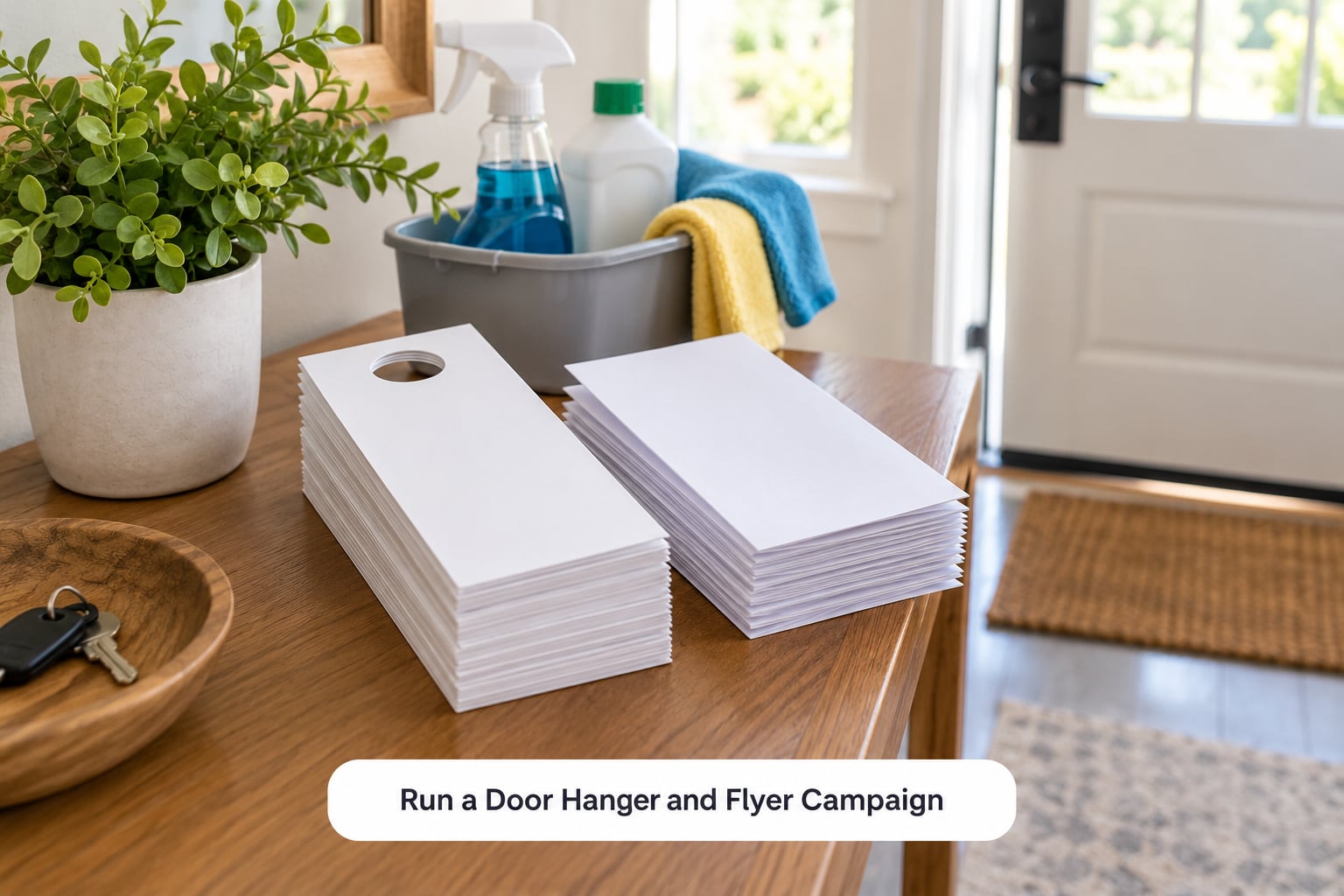
Door hangers work, but only when they look like the work and not like litter. The technique is simple: after finishing a job, drop hangers on the surrounding doors inside a one-block radius, where the clean home makes the offer obvious.
Keep the copy specific. “We cleaned the home next door” beats a vague slogan. Name one concrete offer, include a way to book in two taps, and put the same design on both sides of the flyer and the hanger so the whole piece feels deliberate.
Stay inside local rules. Many municipalities restrict where you may place materials, and littering is an easy way to earn a complaint. Stick to residential blocks in your actual service area, respect do-not-disturb requests, and never cover a notice on someone’s door.
6. Turn a Service Vehicle Into a Mobile Billboard
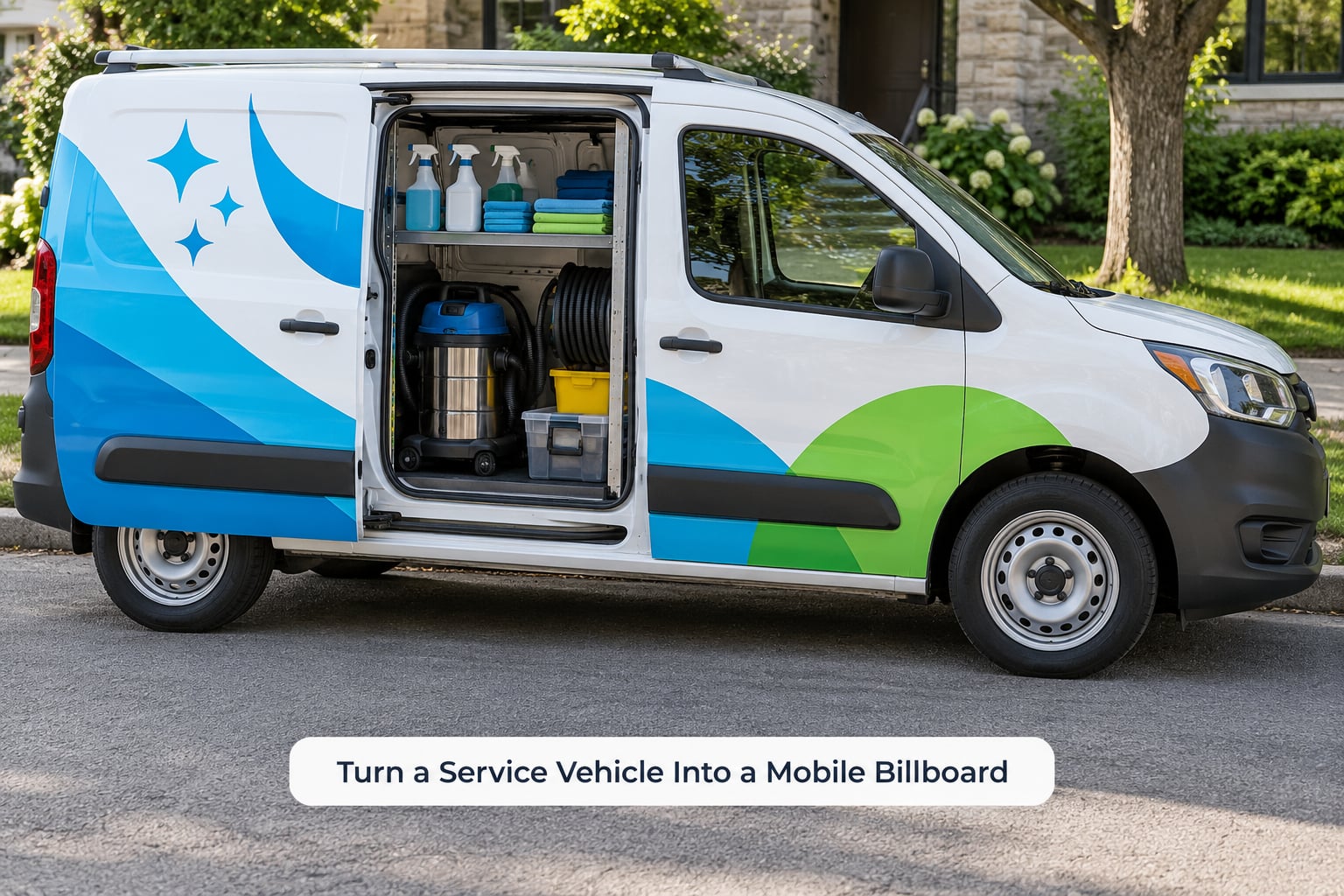
A service van parked at a curb for two hours is repeated exposure for every person on that street. Vehicle graphics or a partial wrap turn that parking time into marketing, which matters most in residential areas where driveway cleaning is visible.
Readability beats decoration here. The service name, phone number, and service area should be legible from a moving car at night. A simple high-contrast layout on the rear doors and both sides usually outperforms a busy full-body wrap.
The credibility signal matters as much as the text. Clean, organized equipment visible through the windows tells a passerby the work is professional. If your van looks like a storage unit, the wrap cannot rescue it.
7. Use Branded Lawn Signs Responsibly
Lawn signs are a burst channel, not a background channel. They earn their cost during a concentrated push: a move-out season, a new rental community you are servicing, or a 30-day campaign.
Keep the message to three things, the service, the offer, and how to respond. Place signs where your existing customers are, not scattered across town, since a sign next to a home you cleaned converts far better than one at a random intersection.
Check your local sign ordinance before you print, remove them the day the campaign ends, and never place a sign on property you have not cleaned. An abandoned sign in a yard is the fastest way to make a neighbor your enemy.
8. Send a Targeted Direct-Mail Offer
Untargeted mailers get thrown away. Narrow the list first: houses in one or two zip codes that match your ideal client, or offices of a specific size in a business district where you want janitorial work.
One strong offer beats three weak ones. A postcard with a single seasonal offer and a QR code that opens a booking page will outperform a glossy general flyer every time.
Give the mailer its own response code or keyword so replies and bookings separate from everything else. Direct mail is easy to measure precisely and impossible to measure at all if you skip that step, which is why so many owners assume it does not work.
9. Sponsor a Relevant Community Event
Sponsorship works when the event already draws your customer. A school fundraiser, a neighborhood association gathering, a sports league for local families, or a small business chamber mixer all put you in front of owners who make the buying decision.
Offer something useful rather than a banner. A free home air-move checklist, a donation matched per booking, or a short talk on keeping a home clean between professional visits all read as contribution, not advertising.
Display your service details where people can actually read them, and collect opt-in contacts with a sign-up sheet that says what they will receive and how often. Do not outshine the organizer. People remember who helped and quietly resent who took over. This is also the natural place to fold in community groups: be a visible neighbor, not a billboard.
10. Launch a Two-Sided Referral Offer
Referrals are the highest-quality lead most cleaning companies get, but most lose them by never asking. Ask every satisfied client, once, in person, with a specific request.
Reward both sides. The new client gets something concrete on their first clean, and the referrer gets a credit toward their next service or a cash equivalent. Two-sided works better because the existing client has no skin in the outcome otherwise.
Write simple rules: credit applies to the first clean only, the offer expires after a set period, and both sides need completed service before it applies. Then track how many referrals you send and how many convert. If nobody books after ten asks, your ask is the problem, not your customers.
11. Publish Before-and-After Cleaning Examples
Before-and-after photos are the one piece of content owners report consistently bringing inbound interest. They prove quality faster than any claim you could write.
Photograph real jobs: the same kitchen sink before and after, a baseboard, an oven interior, a vacated apartment. Ask permission in writing before anything goes online, and include a clear explanation of the challenge along with the result. That pairing is what makes the photo useful.
Place these on your own site as a gallery, on your Google Business Profile, and in the community groups where you already participate. Businesses that photograph consistently build a portfolio that no competitor can copy and no stock image can fake.
12. Reconnect With Past Customers by Email
Your past customers are the cheapest audience you will ever reach, and most cleaning businesses ignore them between campaigns. A short monthly email is enough.
Keep the tone restrained. A seasonal checklist, a reminder that high-touch areas need attention twice a year, a short note about what your crew has been working on, and one clear reason to book. No pressure, no constant discounting.
Segment the list lightly if you can: one-time move-out clients get a different message from weekly recurring clients. Reactivation here usually beats cold outreach, and it costs nothing but an hour a month.
13. Use Local Social Media Groups Carefully
Neighborhood groups are genuinely valuable when you are new, because members will talk to someone they can see locally. They are also the fastest way to get removed, and removal is nearly permanent.
Follow a few hard limits. Contribute advice on cleaning questions without a link unless someone asks for one. Never drop your service details into a thread that is not about your service. Ask before sharing any photo that includes someone else’s home. Reply to a comment once, then move the conversation to private if it continues.
Share completed work only where the group welcomes it, mention the neighborhood by name when relevant, and point interested people to one clear contact page rather than your whole website. Owners in these threads describe the same thing repeatedly: people reward usefulness and punish repetition.
14. Create Season-Specific Cleaning Offers
Cleaning demand moves with the calendar, and a named seasonal offer converts better than a general discount because it matches what people are already thinking about.
Map the demand first: spring move-out cleaning as leases end, summer rental and short-stay turnover work in vacation markets, pre-winter exterior and gutter-season home maintenance in colder regions, and office deep cleans before year-end when managers are closing budgets. Where you operate decides which of these apply.
Run each offer for a defined window with a clear end date. Scarcity that is real creates urgency; a deadline you keep moving tells customers your pricing is arbitrary, and it makes discounting a habit you cannot undo.
15. Run a Repeatable 30-Day Local Campaign
The 15 ideas above work better as one campaign than as 15 separate experiments. Pick a single service area, a single audience, and a single offer, then run every tactic that reaches them for 30 days.
Turn local marketing ideas for a cleaning business into a 30-day plan
Week one, foundation. Finish the Google Business Profile, fix the booking link, add photos, and set up one trackable number so you can attribute calls from the start.
Week two, outreach. Drop door hangers and mailers inside the chosen area, ask ten current clients for a referral, and contact three local partners. Run all of it in the same zip codes.
Week three, conversion. Publish three before-and-after examples, post the seasonal offer, and answer every inquiry the same day. Follow up with a text and an email, then a call, then one final message.
Week four, review. Count booked jobs by source, total the cost, and compare against revenue. Keep the two channels that produced booked jobs, drop the rest, and repeat next month with a different offer.
Frequently Asked Questions
What is the best local marketing channel for a small cleaning business?
The Google Business Profile paired with a steady flow of reviews is usually the best starting channel, because it is free and it appears directly on map and near-me searches. Add referrals early since they close fastest and cost nothing. Paid ads come last, once the profile is complete and reviews are flowing.
How much should a cleaning company spend on local marketing?
Spend enough to cover print materials, a trackable phone line, and a modest ad test, then judge each channel by booked-job cost rather than impressions. Owners who are unsure often do better for a season by funding print and photo work instead of ads. Revisit the split once you know which channel produced actual bookings.
Should a cleaning business target homeowners or commercial clients first?
Pick one and commit for at least a season. Residential clients book fast and give referrals but churn when they move. Commercial accounts are slower to close and steadier once signed. Choose based on your crew, your vehicle, and your local market rather than on what sounds more impressive.
How can a cleaning company track offline marketing results?
Give every offline campaign its own code, keyword, or short link, then ask new customers how they heard about you when you call for confirmation. Door hangers, mailers, and event sign-ups all need distinct identifiers. Without one, offline tactics get judged by feel and then blamed for failing.
What promotion works best for a new cleaning business?
A specific first-job offer paired with visible proof of work tends to work best when you have no reviews yet. Photograph your first few jobs, publish them with permission, and ask each client for a review and a referral in the same conversation. Avoid deep discounts, which attract price shoppers who leave quickly.
Conclusion
Pick one service area, one audience, and one offer before you spend anything else. Complete your Google Business Profile this week, ask your first ten satisfied clients for a review and a referral, then run a single trackable neighborhood offer so you know what worked.
Most owners do not need fifteen channels. They need one sequence they actually finish, which is why these 15 local marketing ideas for a cleaning business are ordered the way they are.