If your banner hangs on a chain link fence, scaffolding or anywhere wind can reach the full face of the panel, choose mesh. If it hangs indoors, flat against a storefront wall, or inside a trade show booth where color depth and crisp small type matter more than surviving a gust, choose solid vinyl. That is the whole decision in one sentence.
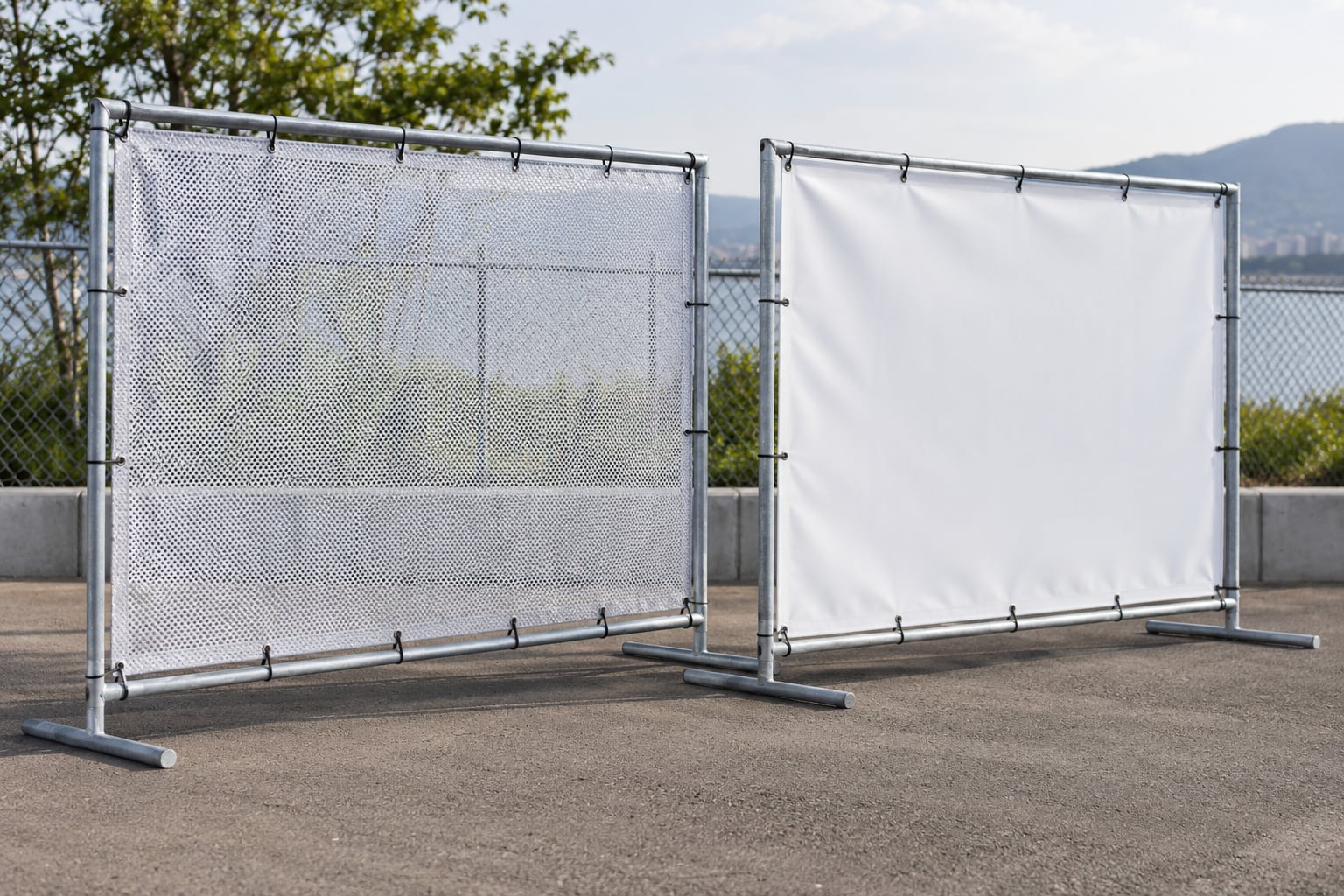
Everything after that sentence is detail, and the detail matters more than most sellers will tell you. A mesh banner is printed on perforated PVC-coated polyester, a woven screen with a regular pattern of small holes across the entire face. A solid vinyl banner is printed on a closed, non-perforated PVC-coated scrim that blocks all airflow. Two different materials, two different jobs.
I have watched owners order the wrong one and then blame the printer. Nothing is wrong with either material. It was simply asked to do a job it was not built for, and the replacement cycle starts on day one. This guide walks through what each material is, how wind loads a panel, what happens to your artwork on a perforated surface, how to mount each one, and how to pick in about ten seconds once you know your site.
Table of Contents
- Mesh Banner vs Solid Vinyl Banner at a Glance
- What Is a Mesh Banner?
- What Is a Solid Vinyl Banner?
- Mesh vs Solid Vinyl: Wind and Weather Resistance
- What wind slits do, and why they are a patch
- Rain, sun, and lifespan
- Print Quality, Color, and Visibility
- Durability, Weight, and Installation
- Cost and Best Uses
- Which material fits which site
- Which Should You Choose?
- Frequently Asked Questions
- Is a mesh banner better than a vinyl banner?
- How long do mesh banners last?
- What is the best material for banners?
- Are mesh banners see through?
- Are vinyl banners waterproof?
- What are grommets on a vinyl banner?
- Conclusion
Mesh Banner vs Solid Vinyl Banner at a Glance
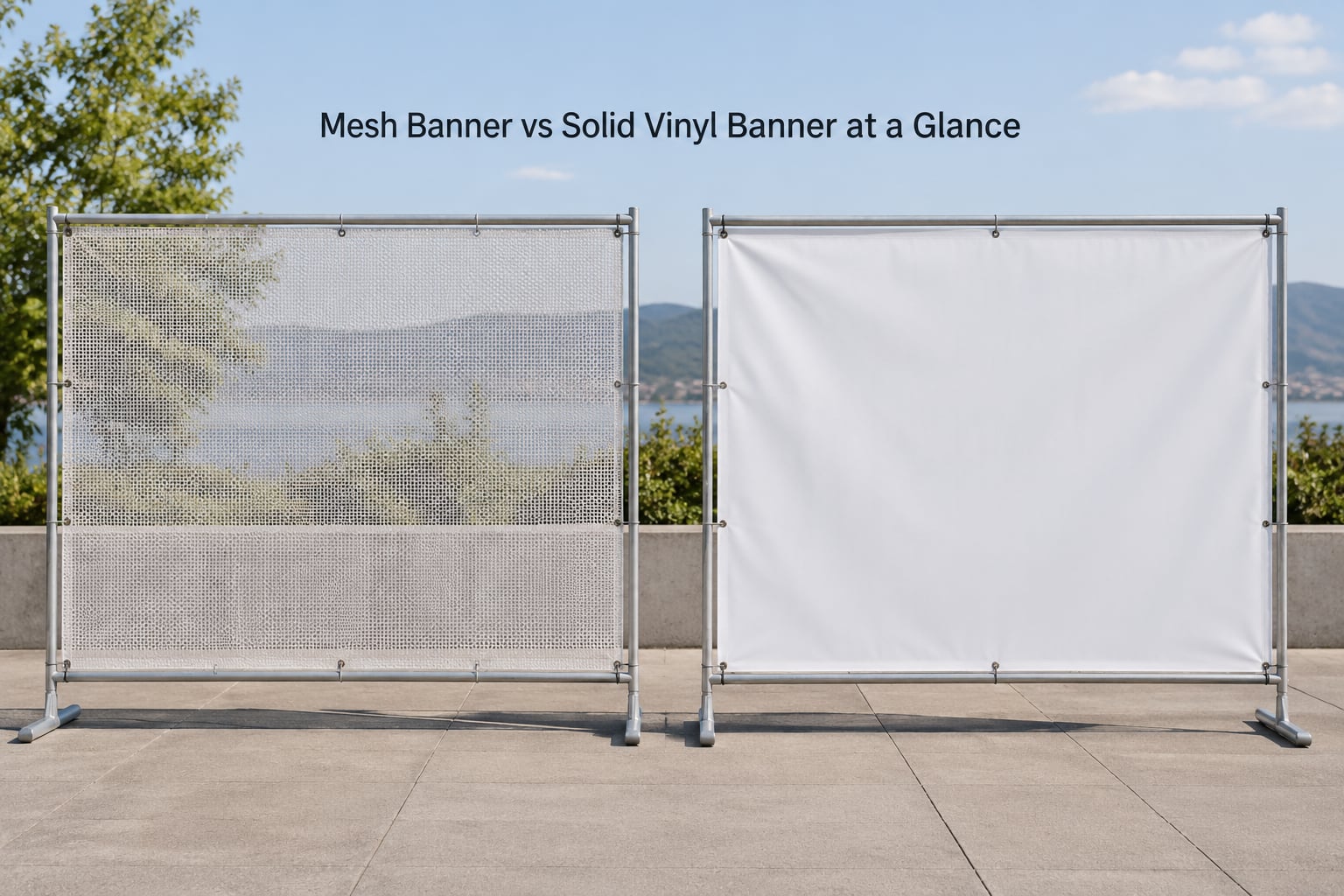
The table below is the short version. Read it top to bottom and the pattern is obvious: mesh buys you wind tolerance and gives up some print punch, solid vinyl buys you color and clarity and asks you to mount it carefully.
| Criterion | Mesh banner | Solid vinyl banner |
|---|---|---|
| Material | Perforated PVC-coated polyester scrim, open weave | Closed non-perforated PVC-coated scrim, blockout available |
| Typical weight | 8 oz per square yard | 13 oz, with 15 oz for heavy duty |
| Airflow | Air passes through the weave | Air has to go around the panel |
| Wind resistance | Strong; built for exposed outdoor sites | Fair; needs secure mounting in wind |
| Print clarity | Softened; small type breaks up | Crisp at reading distance |
| Color vibrancy | Slightly washed; saturation is boosted to compensate | Full saturation, solid color fields |
| Light passage | Semi-transparent; you can see light and shadow through it | Opaque, blocks light between faces |
| Typical failure mode | Edge fray at the hem line | Tear-out at corner grommets |
| Mounting | Grommets every 2 ft, pole pockets, slack ties | Grommets every 2 ft, hem, pole pockets |
| Best environment | Fences, scaffolding wraps, building wraps, roadside | Indoor, storefront, retail window, trade show |
One row deserves emphasis before you go further. Weight is not a detail here, it is the reason mesh behaves differently in your hands and on your fence. Mesh at 8 oz per square yard is light enough that two people can raise a large panel without a lift, and light enough that wind has less mass to push against. Solid vinyl at 13 oz, and 15 oz for extra-heavy duty, holds a flat plane on a wall and resists abrasion, but it is also the panel that behaves like a sail when it is free-standing.
What Is a Mesh Banner?
A mesh banner is printed on perforated PVC-coated polyester scrim. The holes are the product, not a defect. They are part of the weave, they run in a regular grid across the entire face, and they are what makes the material behave differently from solid vinyl in wind.
Three things follow from those holes. First, airflow moves through the panel instead of loading it, so the banner flexes rather than billows. Second, light passes through, which means anything behind the banner shows through faintly as shadow or color, and any sunlight behind it lifts the printed image. Third, the ink has less surface to sit on, so fine detail softens and large solid areas look slightly thinner than the same artwork on solid vinyl.
Installers describe it as a picture with holes in it, and that phrase exists for a reason. Buyers see the finished panel, decide it looks faded, and file a reprint complaint against a print that is exactly what the material produces. Before you order mesh, you should accept the look. Ask for a physical sample if the job is large.
One photograph will not prepare you for it. Mounting samples on your own fence, in your own light, at your own viewing distance is the only reliable test.
What Is a Solid Vinyl Banner?
A solid vinyl banner is printed on a closed, non-perforated PVC-coated scrim. There is no open weave, so nothing passes through the face. That single fact explains both its advantages and its failure mode.
Because the surface is continuous, ink lays down on an uninterrupted plane. Colors stay saturated, fine rules stay sharp, small type stays legible at distance, and photography looks like photography. The panel is also opaque, so a storefront window or a trade show backdrop blocks whatever is behind it and reads cleanly against a crowded background.
Weights matter here. 13 oz scrim vinyl is the standard for most printed banners, and 15 oz is specified when the panel will be handled hard, mounted low where people brush past it, or used for longer runs on a wall. Blockout construction adds an opaque core between the faces so the two sides do not ghost into each other, which matters when the front and back carry different artwork.
Solid vinyl is also easier to finish and harder to fray. The hem line has solid material to sew or heat-weld into, so hems and eyelets behave predictably. On mesh, the perforations weaken the edge and make hemming more labor-intensive.
Mesh vs Solid Vinyl: Wind and Weather Resistance
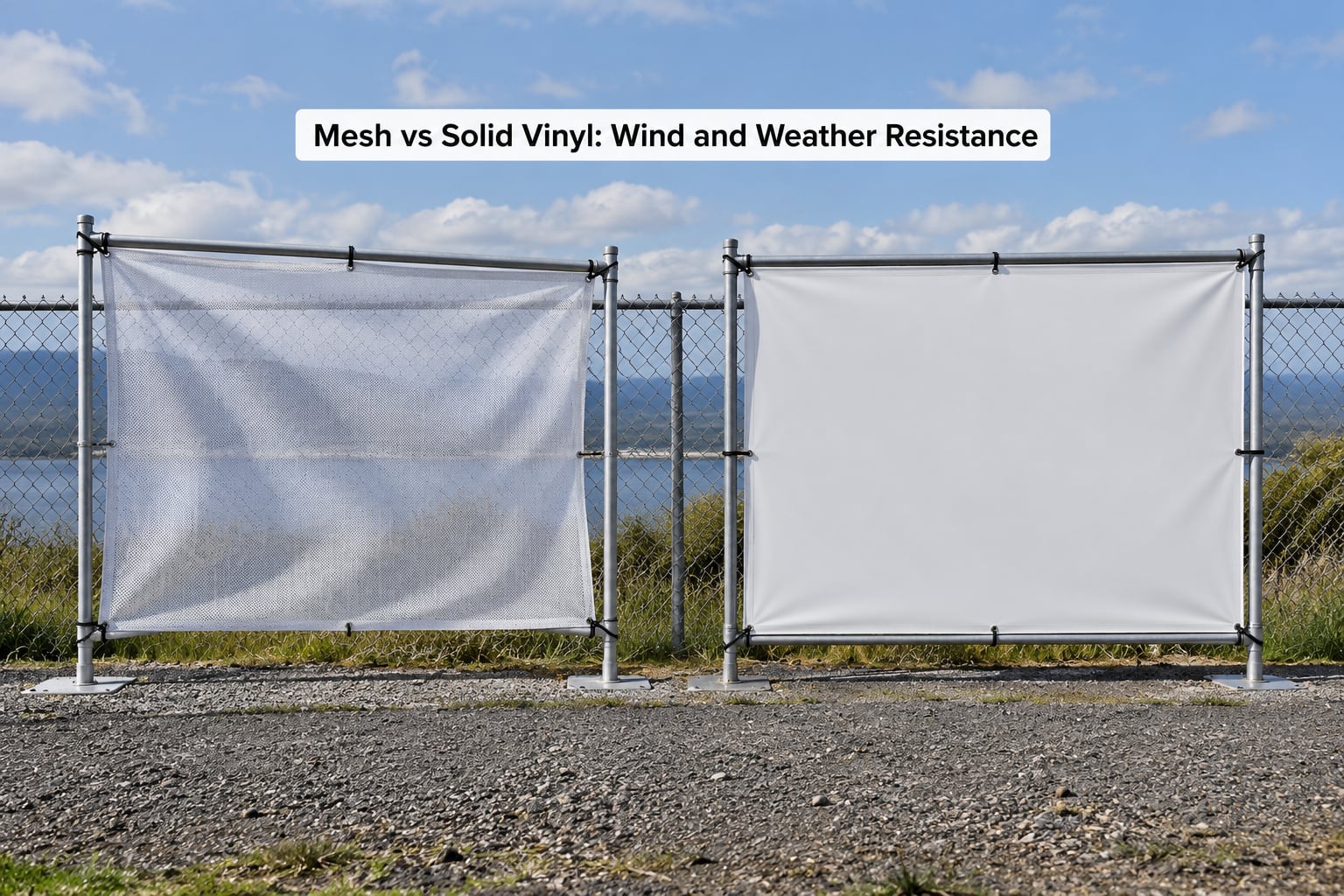
Wind is where the mesh banner vs solid vinyl banner decision is really decided, and the mechanics are simpler than most explanations make them sound.
Wind hitting a solid vinyl banner cannot pass through it. The panel behaves like a sail. It bows, it luffs, and the load travels out to the edges until it concentrates on the corner grommets, which is exactly where fence banners fail. Ask any installer which part of a torn banner gave way first and the answer is almost always a corner, never the middle of an empty panel. That is load concentration, and it is the whole argument for mesh.
Mesh gives the air a way through. Pressure dissipates across the weave instead of driving the panel outward, so the banner moves in wind rather than fighting it. On a construction fence, a scaffolding wrap, a building facade or a roadside installation, that difference decides whether you replace the sign once or several times a season.
What wind slits do, and why they are a patch
Wind slits are knife cuts made in a solid vinyl panel to release pressure. Installers reject them for a good reason: every slit is a tear starter. A slit removes a small share of the face area, so the pressure reduction is modest, and it leaves a cut edge that propagates under repeated loading. Practitioners on signage forums describe mesh as the real fix and slits as a patch on a panel that was never the right material for the site.
Rain, sun, and lifespan
Both materials handle rain well. Coated PVC scrim is water repellent, and neither material soaks up rain like fabric does, so a wet banner dries rather than swells or sags. This is the honest part of the waterproofing question: the material is not the weak point outdoors. Mounting is.
UV fade is the other half. Solid vinyl holds color a little longer under direct southern and western exposure because it has a continuous surface and usually carries a heavier coating. Mesh fades a little faster, particularly in saturated colors, which is one more reason printers boost saturation on mesh artwork.
Lifespan ranges for these materials typically run from one to three seasons outdoors depending on climate, exposure and mounting quality, with heavily wind-exposed installs on the shorter end. If a panel needs to come down, take it down rather than leaving it tattered in place.
There is also a third path worth knowing. Street pole banners use a sleeve rather than grommets, so the load is carried by the pole and top arm instead of by tie points. If your site is a sidewalk or a parking lot and the wind is the problem rather than the mounting, a pole banner can be the cleanest answer.
Print Quality, Color, and Visibility
This is the trade you accept when you choose mesh, and it is worth being specific about so you do not pay for artwork that will never work on the material.
Cap height is the practical rule. Give yourself roughly 1 inch of letter height for every 10 feet of viewing distance. On a fence read from a road at 60 feet, that means 6 inch type minimum. On mesh, add margin, because the holes soften edges and thin strokes first.
What survives on mesh: heavy display type, large logos with thick strokes, solid color blocks, big numbers, short taglines. What breaks up: hairline rules, thin reversed text, fine gradients, small body copy, delicate line art. A mesh print with heavy saturation looks noticeably better than one printed straight, so tell your printer the material before they quote the file.
Visibility has two halves. Mesh reduces glare, because the perforated face scatters light instead of reflecting a hard sheet of it, and mesh filters sunlight, which helps on a fence where sun hits the panel from behind. Against that, mesh is semi-transparent, so shadows and bright shapes behind the panel show through the artwork.
Double-sided work is where blockout earns its place. Mesh printed on both faces lets a faint ghost of the far side show through, and when the two faces carry different artwork that ghost reads as a printing error. Blockout vinyl with an opaque core is the correct build when the front and back differ.
For a storefront window, be clear-eyed about what you need. A banner is a solid sign hung or bracketed on glass. Partial see-through on glass is a window film problem, not a banner problem.
Durability, Weight, and Installation
Material choice matters less than mounting, and that is the consensus long held by professional installers. A properly secured and correctly tensioned solid vinyl banner in a sheltered position will match a mesh banner in a storm. Equally, mesh mounted drum-tight will fail early and take a fence with it.
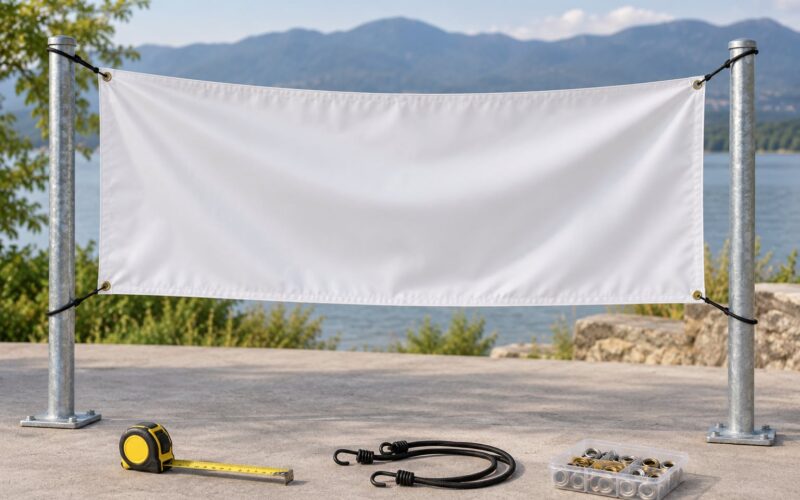
Finishing comes first. Most banners are hemmed all round, then fitted with metal grommets spaced about every 2 feet along the edges, or made with pole pockets and a top sleeve for a frame. Specify hems and grommets explicitly; a raw cut edge is the first thing to go on either material.
Tension is the part installers argue about. Leave slack in the ties so gusts are absorbed rather than transferred into the panel. Add an extra tie between grommets at exposed corners. Panels pulled drum-tight rattle, and rattle is what cuts a grommet hole into a tear.
Free-spanning installs need a different conversation. A banner tied flat to a chain link fence is supported along its whole edge. A banner stretched between structural columns carries its own load across a span, and that is an engineering question, not a signage one. If that is your situation, get the structure checked before the fabric goes up.
Weight follows the material. Mesh at 8 oz is easy to raise, roll and rehang, which matters for trade shows and short-term event installs. Solid vinyl at 13 oz is noticeably heavier but holds a flat plane on a wall and shrugs off handling and abrasion.
Maintenance is simple for both, with one mesh-specific note: the open weave collects dust and dirt over time, and a periodic hose-down keeps it looking new. Solid vinyl wipes clean and does not trap dirt in a weave.
Cost and Best Uses
Per square foot, the two materials sit close together, and total project cost is driven more by the choices around the material than by the material itself.
What actually moves the cost: size, print method and number of colors, finishing (hem and grommets versus pole pockets versus a sewn frame), mounting hardware, shipping and labor for installation, and expected duration of the install. A 15 oz blockout double-sided banner with sewn pockets costs more to produce than a single-sided 13 oz panel, and neither of those numbers changes because you switch to mesh. The real question is how many times you plan to reprint.
Total cost of ownership is the honest way to compare. If a solid vinyl banner on an exposed fence lasts four months and you replace it three times a year, the unit price stopped mattering after the first reprint. Include labor: taking down a torn corner and re-hanging is the cost most buyers forget, and it lands on the same person every time.
Which material fits which site
| Environment | Recommended material | Why |
|---|---|---|
| Chain link construction fence | Mesh | Constant airflow, exposed corners, long duration |
| Scaffolding or building wrap | Mesh | Large free area catches wind at height |
| Roadside and highway-facing | Mesh | Wind pressure from traffic and open exposure |
| Event and festival signage | Mesh | Temporary outdoor install, likely to move and rehang |
| Retail storefront wall | Solid vinyl | Flat mount, color and small type matter |
| Trade show or indoor backdrop | Solid vinyl, blockout | Controlled light, opaque background, reuse |
| Retail window | Solid vinyl | Opacity and clean edges against glass |
| Restaurant patio or awning | Solid vinyl | Short duration, close viewing, no wind load |
| Municipal or public installation | Mesh, or pole banners | Exposure and replacement labor, not unit price |
Large fence and building wraps can pull a sign permit depending on your city, and roadside installations often trigger additional review. Check locally before you commit to a date; it is a two-week conversation that saves a reprint.
Which Should You Choose?
Mesh for exposed, windy outdoor locations. Solid vinyl for indoor displays, storefront walls, photography, and any graphic where an opaque background or small-type crispness is part of the message. That is the rule, and it holds up in almost every case.
Four questions settle it in under a minute. Can wind reach the full face of the panel? If yes, mesh. Does the artwork contain small type, thin rules or photography? If yes, solid vinyl. Is the panel tied flat to a fence or scaffold, or free-spanning? Tied flat favors mesh; free-spanning needs an engineering check on either material. How long does it need to stay up? A single event on calm ground can go either way; a seasonal install on an exposed site is a mesh decision.
And know when not to use mesh. Skip it for retractable banner stands and any indoor fixture, for window graphics, for logo-critical brand work viewed close up, and for anything where a customer will judge the color accuracy rather than the wind tolerance.
Send your printer the site conditions, not just the size. Exposure, mounting method, viewing distance and how long it stays up are the four inputs that determine the right build, and they take you two minutes to write down.
Frequently Asked Questions
Is a mesh banner better than a vinyl banner?
Neither is better in general. Mesh is better for exposed outdoor installs on fences, scaffolding and roadside sites because air passes through the weave. Solid vinyl is better indoors, on storefront walls and for photography or small type because its closed surface keeps colors saturated and type sharp. The right answer depends on the installation environment, not on the material itself.
How long do mesh banners last?
Outdoor banners of either material typically last one to three seasons, depending on climate, sun exposure and mounting quality. Wind-exposed mesh generally outlasts wind-exposed solid vinyl. If a banner starts to look tired, take it down and replace it rather than leaving a torn panel in place.
What is the best material for banners?
There is no single best material. Mesh is the best choice for chain link fences, scaffolding wraps, building wraps and roadside signage where wind is the deciding factor. Solid vinyl is the best choice for indoor displays, storefront walls, retail windows and any artwork needing an opaque background and crisp small type. Mounting quality affects lifespan as much as material.
Are mesh banners see through?
Mesh banners are semi-transparent. Light passes through the perforated weave, so shadows and bright shapes behind the panel show faintly through the artwork, and sunlight from behind lifts the printed image. Mesh reduces glare and filters harsh light. If you need full opacity, choose solid vinyl, or blockout vinyl with an opaque core.
Are vinyl banners waterproof?
Printed vinyl banners are effectively waterproof for outdoor use. Coated PVC scrim does not absorb water, so a wet banner dries rather than swelling or sagging. Neither material is the weak point in a typical install. The bigger causes of early failure are mounting tension, UV fade over time and torn grommets from wind loading.
What are grommets on a vinyl banner?
Grommets are the reinforced metal eyelets set into a banner’s hem, and ties or hooks pass through them to secure the panel. Most banners carry grommets roughly every 2 feet along all edges. Alternatively, pole pockets and a top sleeve mount a banner to a frame or pole. Specify hem and grommet finishing when you order, since a raw cut edge frays first.
Conclusion
The mesh banner vs solid vinyl banner choice comes down to one thing: where the wind is. Mesh gives up a little color punch and small-type crispness and gets you a panel that survives exposed outdoor mounting. Solid vinyl gives up wind tolerance and gives you the sharpest, most saturated print you can hang.
Start with the installation environment, then check your artwork against the cap-height rule, then decide how long it needs to stay up. Write those three things down, send them to your printer with the size, and you will get a quote for the right material instead of a quote for the wrong one.