Quick answer: a table throw dresses the table and works at close range, so buy it when people walk right up to your booth. A banner carries a message at a distance, so buy it when you need foot traffic from across the room or the aisle. For most events with fewer than 25 people, the throw alone is enough.
Updated for 2026. If you are staffing one table in a room you do not control, this question comes up constantly. The venue hands you a folding table, the floor space is whatever is left over, and you have a modest budget for whatever makes the table look intentional.
The honest answer is that these two items solve different problems, and the one most people need is the one they have not thought about yet. A throw makes a surface look finished. A banner makes a message visible. Buying both at small-event scale is often wasted spend, and buying the wrong one leaves you with a bare table or a sign nobody can see.
Table of Contents
- Table Throw vs Banner for Small Events at a Glance
- What a table throw actually is
- What a banner actually is
- How they divide the job
- What Looks More Professional at a Small Event?
- The close-range surface: why a throw reads as finished
- The vertical focal point: why a banner reads as official
- Which Is Easier to Set Up and Transport?
- Setting up and packing down
- Carrying between events
- How Does Each Option Affect Visibility?
- Which One Is More Budget-Friendly?
- What Can You Reuse Each Display For?
- What a table throw works for
- What a banner works for
- Table Throw vs Banner: Which Should You Choose?
- Frequently Asked Questions
- Can a table throw work instead of a banner for a small event?
- Is a banner better than a table throw for a vendor booth?
- Are table throws or banners better for outdoor events?
- What is the easiest way to make a small event display more visible?
- Which option is cheapest for a one-time event?
- Should a small business use both a table throw and a banner?
- Conclusion
Table Throw vs Banner for Small Events at a Glance
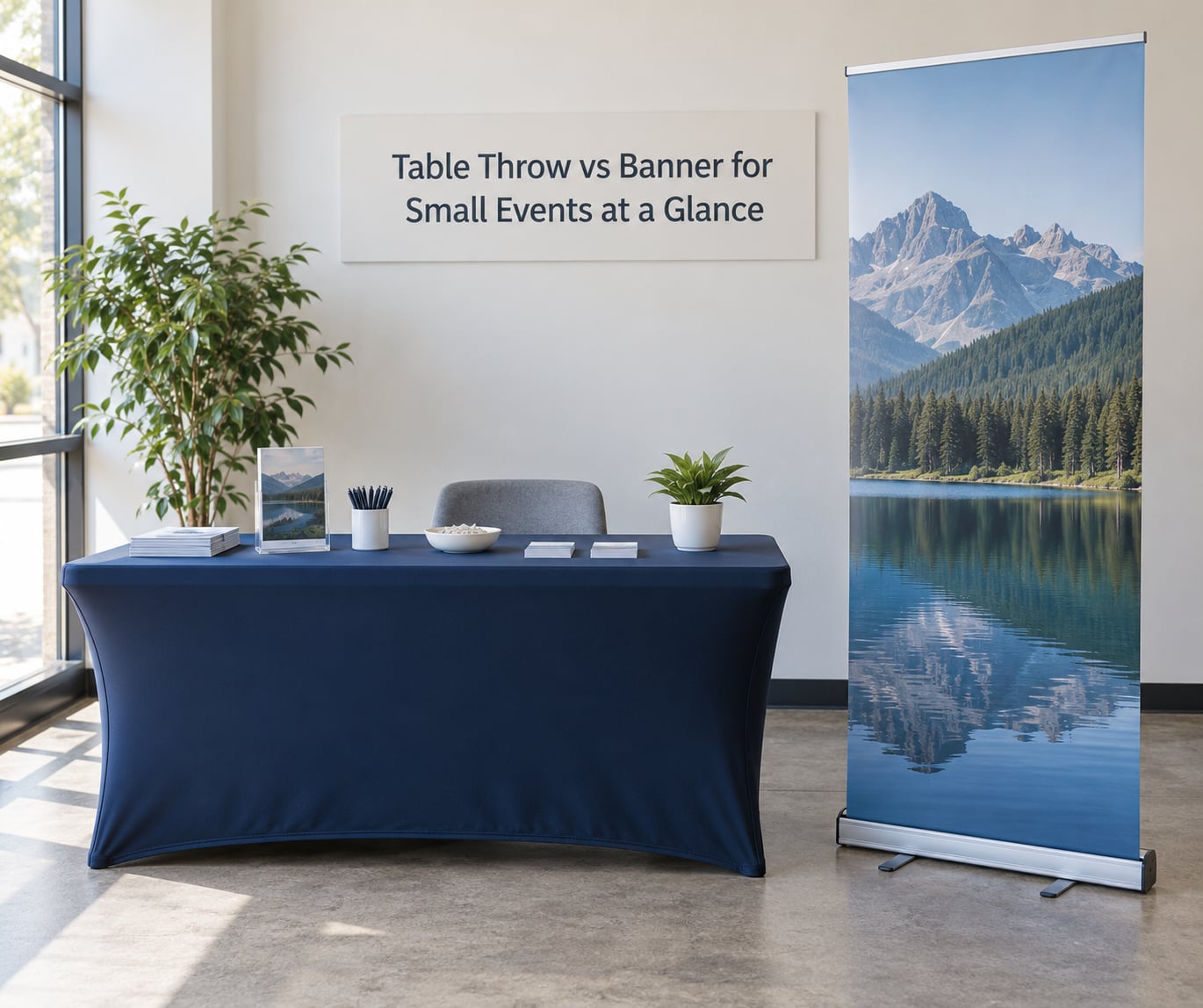
The table below is the whole comparison. Everything after it is just the reasoning behind each row.
| Factor | Table throw | Banner |
|---|---|---|
| What it is | Fabric cover sewn to one exact table size | Printed graphic on a stand, wall, or frame |
| Primary job | Makes the table look finished and branded | Carries a message people can read from a distance |
| Works best at | 2 to 6 feet | 10 feet and up |
| Typical sizes | 6ft table 84 x 126.5 in, 8ft table 84 x 150.5 in | Mini retractable 33 x 80 in, full retractable 33 x 80 in or 44 x 80 in |
| Setup time | Under a minute, drape and smooth | 1 to 2 minutes, pull the base out of the case and roll up |
| Transport weight | Folds flat into a tote, very light | Base and roller live in a hard case, noticeably heavier |
| Outdoor use | Fine in light wind, poor in a gust | Weighted base holds better, but vinyl adds sail area |
| Reuse across events | Machine washable, graphic never expires | Stand reused forever, graphic replaced when messaging changes |
| Best event types | Registration tables, market stalls, product demos, vendor tables | Trade show booths, market entrances, conference rooms, directional signage |
| Main drawback | Only works for people already standing at the table | Costs more, takes floor space, needs somewhere to stand |
What a table throw actually is
A table throw is a full cover of printed fabric, usually around 9oz polyester, cut and sewn to the exact dimensions of one table. It drapes over the top and down all four sides, hiding scuffs, tape residue, and the mismatched folding tables that venues hand you.
Because it is fitted, the size is not adjustable. A throw cut for a 6ft table will not fit an 8ft table properly, which is why measuring the actual table matters more here than it does with a banner. Print is usually dye sublimation, where dye bonds into the fabric rather than sitting on top, so the graphic will not crack or peel and the material stays washable.
What a banner actually is
A banner is a printed graphic mounted on hardware. The common small-event formats are a retractable or roll-up banner, an X-frame banner, and a tabletop display that sits on the table itself. The graphic itself is most often 13oz blockout vinyl or a tension fabric pillowcase, mounted on an aluminum base.
One term causes a lot of confusion. A tabletop banner is a small stand that sits on top of a table, not a banner that hangs off the front of it. Both exist, and vendors use the words loosely, so check whether the product you are looking at is floor-standing or table-standing before you order. For this comparison, we mean the kind you stand on the floor behind or beside the table.
How they divide the job
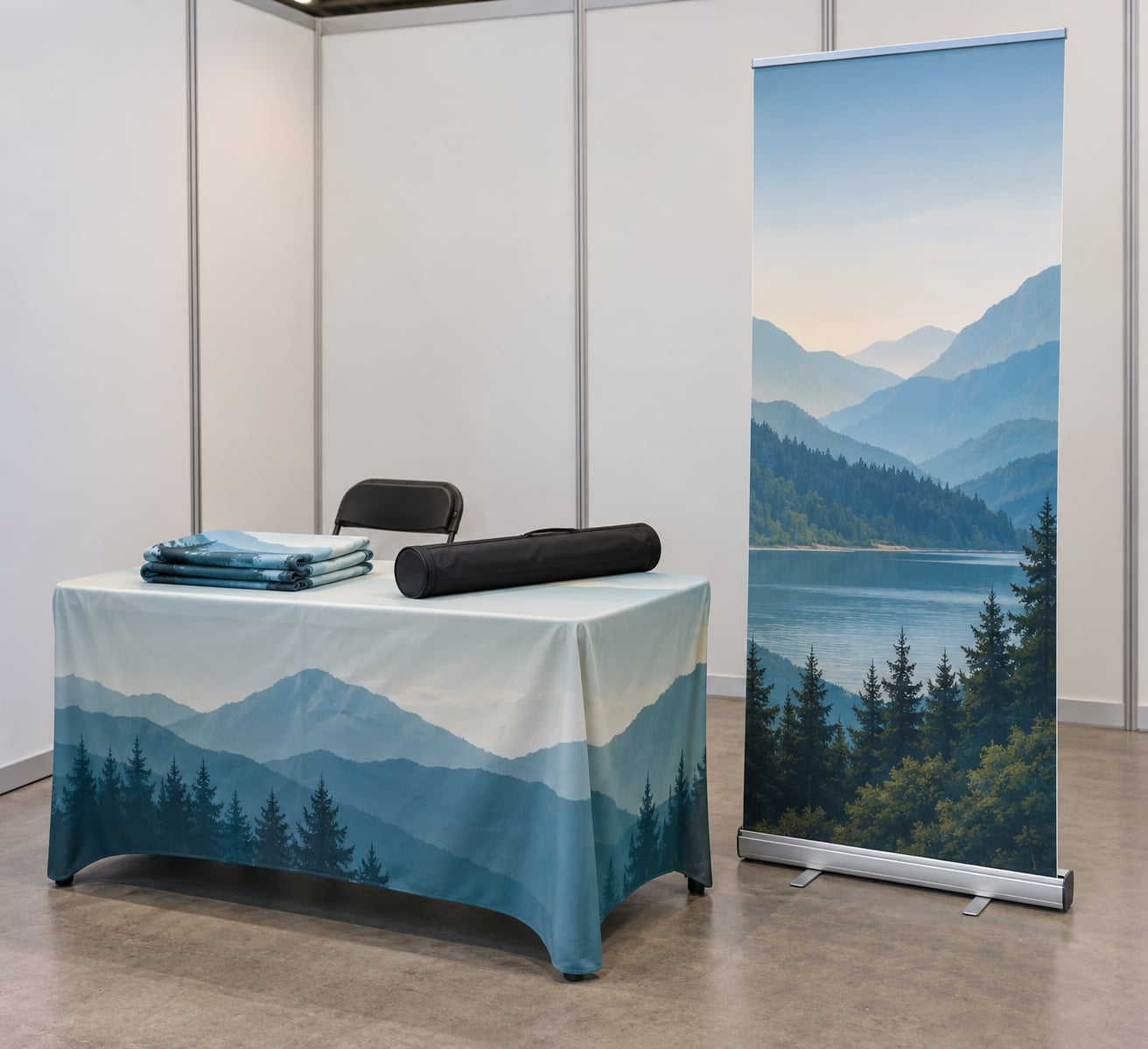
They cover different ground. The throw handles the surface people are standing over, and the banner handles the airspace people are walking past. Neither covers the other, and that is the entire argument for buying one and skipping the other.
What Looks More Professional at a Small Event?
A polished event is a question of what the eye lands on first. A table throw wins the close range; a banner wins the far range.
The close-range surface: why a throw reads as finished
Most small events are conversational. People come to the table, they lean in, they pick something up or sign a sheet. That is the moment a throw earns its cost, because it removes every visual distraction from the surface they are already looking at.
A plain venue table with a faded laminate top and a strip of old tape reads as temporary no matter what is on it. Covering it changes the impression instantly, and it is the cheapest visual upgrade available at an event of this size. It is also the only branded surface a customer will physically touch, which makes the logo placement matter more than the size of any sign in the room.
For photography, the same logic applies. Every phone camera pointed at your booth captures the table in the foreground. A covered table makes those images look composed. A bare table with product boxes on it does the opposite, and no amount of signage above it can fix a badly framed foreground.
The vertical focal point: why a banner reads as official
A banner’s job is different. It tells someone approaching from 20 or 30 feet away what this is, whether they should stop, and what the name is. That is a different question from the one a throw answers, and it is the reason a booth with a banner and no throw can still pull a crowd.
Vertical surfaces also give sponsor or partner logos somewhere to live. A throw has a small front panel and a lot of cloth, so sponsor logos compete with each other for space. A banner is a flat, rectangular print field sized for exactly that layout.
The failure mode here is well documented. Several organizers described putting up a banner at a community-centre venue where nothing else was branded, and it looked borrowed. The table behind it was a bare folding table with tape on it. The banner said company, the table said nobody was in charge, and the contradiction is what people remember.
Which Is Easier to Set Up and Transport?
For a solo vendor hauling everything in one car, this often decides the question before appearance does.
Setting up and packing down
A throw goes on in under a minute. You drape it, center the logo, and pull the corners down until the drop is even. Packing down is folding it into a tote, and it survives being crammed in with other stock.
A retractable banner takes one to two minutes: pull the base out of its case, raise the roller, and attach the graphic. Packing it is the reverse, but the case is a rigid tube that takes up real space in a vehicle. An X-frame is similar, and it is faster still, but it needs a floor area roughly 2 feet by 3 feet to stand in.
That floor requirement is the part people forget. At a busy market or a shared hall, a stand needs somewhere to live that is not in a walkway. A throw needs nothing beyond the table it is already using.
Carrying between events
Fabric wins on weight by a wide margin. A folded throw weighs almost nothing, and organizers on forums regularly describe keeping one in the car permanently. A banner base with its roller is a two-handed carry, and a damaged case means the whole setup is unusable on the day.
Outdoors, a throw is the weaker option. Light wind is fine, but a gust lifts the corners and the drop exposes the table underneath. Banners have a wider footprint and a weighted base, which helps, though large vinyl graphics catch wind like a sail. Neither is a real answer for a windy street, and both are better indoors.
How Does Each Option Affect Visibility?
Visibility is arithmetic, and one rule settles most of it: allow about one inch of capital letter height for every ten feet of reading distance. That single rule tells you whether you need a banner at all.
Work backwards from your space. If someone reads your message at 10 feet, you need roughly one inch of tall letters. At 20 feet, two inches. At 30 feet, three inches. A standard 6ft table is 30 inches tall, which puts the printed area of a throw between about 24 and 40 inches above the floor once the drop is accounted for. That height can carry a logo and a short line of text, and it stops being readable past about 10 feet.
A mini retractable banner at 33 x 80 inches gives you a graphic whose top sits well above head height on a table or on the floor, and its letter sizes can be set for 15 to 20 feet of reading distance. That is the practical gap: the throw covers 2 to 6 feet, the banner covers 10 feet and up. If your attendees arrive at the table rather than scanning for it, the throw is sufficient on its own.
Size the throw to the table, and the numbers are not guesswork. A 6ft rectangular folding table wants roughly 84 x 126.5 inches of finished fabric. An 8ft table wants roughly 84 x 150.5 inches. A round cocktail table takes a different cut entirely, usually a fitted top rather than a drape. Ask the venue for the height and footprint before ordering, because you rarely get to choose the table.
If the venue supplies the furniture and will not tell you the size, measure at the venue or bring a tablecloth you already own as a template. Forum organizers describe ordering covers that turned out to be several inches short, and a throw that stops above the floor looks unfinished in a way that is obvious to everyone except the person who ordered it.
Which One Is More Budget-Friendly?
Neither option has a fixed price, and any figure you find today will be out of date within a season, so the useful comparison is which costs drive the total and how often you pay them again.
Print area is the biggest variable. A throw covers a large surface, but you can often print only the front panel at a lower cost and leave the sides and back in a plain colour. A banner’s graphic is smaller in area but printed at higher concentration because it has to hold up at distance, which usually means better stock and heavier ink coverage.
Material is the second variable. Polyester fabric is the durable choice because it washes and does not scratch. Vinyl is lighter and cheaper per print but is a consumable: it creases permanently, and sunlight and folding leave visible marks. A fabric tension banner costs more up front and holds its appearance far longer.
Hardware is the third. A banner stand is reusable hardware with a replaceable graphic, so the stand is a one-time purchase and the artwork is a recurring one. A throw has no hardware at all. If your logo or message changes every few months, the banner’s cost model suits you. If the design is stable, fabric wins on every reprint.
The honest budget question is events per item. A throw that shows up at 20 markets in a year is being amortized to almost nothing. A retractable stand bought for a single event is nearly pure waste, which is why second-hand stands and leftover blank stock are common at small business sales. Shipping and turnaround matter too, and sewn fabric usually has a longer lead time than a printed graphic, so ordering early matters more for the throw.
What Can You Reuse Each Display For?
Both displays earn their cost through second uses, but the second uses are not the same.
What a table throw works for
- Registration, check-in, and welcome tables at any event you host
- Market and pop-up shop stalls, where the counter is the brand
- Product demonstration tables, with the logo facing the customer
- Community and church events where the table is the only branded surface
- A plain backdrop for small group photos when it is hung on a wall
- Covering mismatched furniture at a venue you do not control
- Directional use, laid flat on the floor with an arrow for a queue or queue line
What a banner works for
- Drawing foot traffic from across a hall or down an aisle
- Marking the entrance to a booth or a market stall
- Signage that identifies a room, a queue, or a check-in desk
- Backdrops for press and product photography at close range
- Interiors, with a simple hanging rail or a stand base
- Repeated use with a new graphic each time your offer changes
- Trade show booths where the stand, not the table, is the brand
Care decides how long either one lasts. Polyester goes in a washing machine on a cool cycle and comes out looking new, which is the main argument for fabric at an event you will repeat. Vinyl needs to be rolled rather than folded, because creases in a folded graphic stay visible even after it is hung.
The common failures are worth knowing. Torn grommets come from hanging a throw by its eyelets when it was not reinforced for that. Wrinkles come from storing fabric rolled damp. Wind-lifted bases come from an unweighted stand on a hard surface. None of these are expensive problems, and all of them are avoidable with a few minutes of care.
Table Throw vs Banner: Which Should You Choose?
Match the display to the shape of your event, not to the size of your logo.
Under 25 people, in a room where everyone is invited to talk to you, the throw is the whole answer. A banner cannot earn its cost in a space that small. Between 25 and 100 people, in a hall with an aisle, the throw covers your table and a small banner is justified if you need people to find you from the door.
At 100 or more, or at any trade show and multi-vendor market, you want both. The throw dresses the table people stop at, and the banner is what pulls them over from the aisle. That is also the only band where buying both is genuinely efficient, because the two are doing two different jobs at the same event.
Here is the decision in four checks. First, how far away is the nearest person who has not met you? Under 10 feet means a throw. Second, how many tables do you have? One or two is a throw problem, a wall of tables is a banner problem. Third, how ugly is the table the venue is providing? Worn and taped means cover it. Fourth, how many events can this item serve? One means buy used or borrow, several means buy new.
Venue rules can override all four. Many halls ban rigging to walls or ceilings, which removes hung banners from the running entirely and leaves you with a free-standing or tabletop display. Some venues require flame-retardant fabric certification for anything draped in their building, so ask before you order. And if the venue supplies the table, you do not control the dimensions, which makes measuring more important than choosing.
What to skip at small-event scale: do not buy a fabric backdrop, a step-and-repeat wall, or a second banner. One well-fitted throw and, if you need it, one small banner is the complete kit. Several organizers described ordering full sets for a small gathering and regretting the spend, and the regret is almost always about the second table, not the first.
Frequently Asked Questions
Can a table throw work instead of a banner for a small event?
Yes, for most small events. A throw covers the table at close range, so it works when people already walk up to your booth or come to a check-in desk by name. You need a banner instead when attendees need to spot you from across a room or an aisle. For an event under 25 people in one room, the throw alone is usually the right call.
Is a banner better than a table throw for a vendor booth?
It depends on how the booth is approached. A banner is better when traffic walks past, because a standing graphic can be read from 10 to 20 feet away and can include a headline. A throw is better when customers stop and lean in, because it covers the whole surface and hides the condition of the table. Busy aisles favor the banner, close conversational events favor the throw.
Are table throws or banners better for outdoor events?
Neither is a strong outdoor choice on its own, and both fail in the same wind. A throw is lighter and lighter wind catches its corners, exposing the table. A banner has a weighted base and a wider footprint, which is more stable, but large vinyl graphics act like a sail. For a street market, a canopy plus a table throw is usually the more reliable combination.
What is the easiest way to make a small event display more visible?
Raise the message instead of adding more of it. Use the reading-distance rule of roughly one inch of capital letter height for every ten feet, and set your type size to match the furthest distance you need to be seen from. A short headline in large type on one banner outperforms a paragraph of small text, and a single large logo on a throw beats a cluttered full-panel design.
Which option is cheapest for a one-time event?
Usually neither, because both are built to be reused. For a single event, borrowing a fitted cover or hiring a printed banner from a local supplier usually costs less than producing either from scratch. If you must buy, a plain fabric cover with a small printed front panel is the cheaper commitment, and it can be sold or given away afterward.
Should a small business use both a table throw and a banner?
Yes, but only when the event has traffic worth catching, which usually means 100 or more attendees or a busy shared market. Below that, the two overlap in what they accomplish and the banner becomes a second expense for the same impression. Cover the table first, then add the message only when you know people will be reading it from a distance.
Conclusion
A table throw solves a close-range problem and a banner solves a distance problem, so the decision comes down to how people reach you. Measure your table or work out how far away your audience will first see you, check what the venue allows you to hang or stand, then buy the display that fixes the visibility problem you actually have.