
How deductibles affect premiums comes down to one trade: the deductible is the slice of a claim you agree to pay yourself, and insurers charge less when you agree to cover more of it. Raise the deductible and the monthly premium drops. Lower it and the premium rises. Rates and rules vary by state and by insurer, so read the figures below as illustrations of the math rather than as quotes.
Table of Contents
- What Is an Insurance Deductible?
- How Deductibles Affect Premiums
- Why Insurers Charge Less for a Higher Deductible
- What Happens When You File a Claim?
- How Much Can Your Premium Change?
- Higher Deductible vs. Lower Deductible: Which Is Better?
- What a deductible does not cover
- How to Choose a Deductible Before Buying a Policy
- Frequently Asked Questions
- Does a higher deductible always mean a lower insurance premium?
- Can I change my deductible after buying an insurance policy?
- Is a 1,000 dollar deductible better than a 500 dollar deductible?
- Do auto and home insurance deductibles work the same way?
- Will my deductible change if I file a claim?
- Should I choose a deductible based on my monthly payment or my savings?
- Conclusion
What Is an Insurance Deductible?
An insurance deductible is the amount of money you pay for a covered loss before your insurer starts paying. It is a number, usually a flat dollar amount, written into the policy next to each coverage it applies to.
It is not the same as the premium, which is what you pay to keep coverage active whether or not a claim ever happens. Nor is it the policy limit, which is the most the insurer will ever pay for that coverage. The deductible is the first layer you pay; the limit is the ceiling above you; the premium is what funds the whole arrangement in between.
How often you pay it depends on the policy. Auto and homeowners deductibles generally apply to each covered claim, so two claims in one year can mean two deductible payments. Health plan deductibles usually run once per plan year, and a family plan carries both an individual deductible and a family deductible that may be embedded or aggregate.
Some coverages carry no deductible at all. Auto liability, for instance, protects other people rather than your own car, so it typically has none. That detail confuses people comparing online quotes, where two policies with identical premiums can hide very different deductibles.
Rules and terminology differ by country and by state, so check your own declarations page and schedule for the exact amounts that apply to you.
How Deductibles Affect Premiums
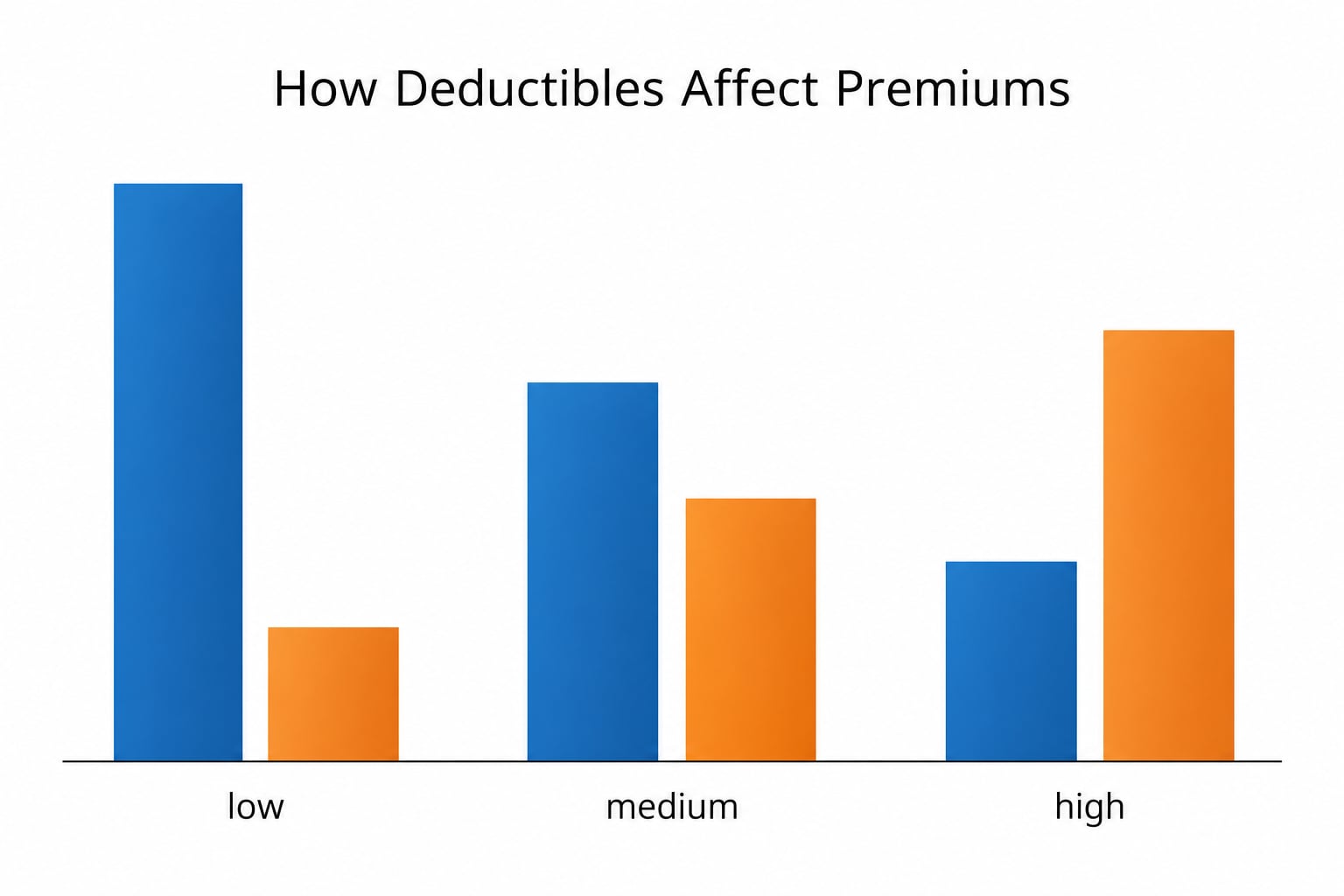
How deductibles affect premiums is a fairly simple relationship to explain: a higher deductible lowers the premium, because you keep more of the risk. The premium you save is rarely as large as people expect, and the amount you take on per claim grows every time you move up a tier.
| Deductible tier | Illustrative monthly premium | You pay per covered claim |
|---|---|---|
| Low (500 dollars) | 115 dollars | 500 dollars first |
| Medium (1,000 dollars) | 92 dollars | 1,000 dollars first |
| High (2,500 dollars) | 78 dollars | 2,500 dollars first |
These numbers are invented for the example, not taken from any insurer. The shape of the trade is real even though the amounts are not: a 500 dollar deductible to 2,500 dollars saved about 37 dollars a month in this sketch, or roughly 440 dollars a year, while the money at risk on a single claim went up by 2,000 dollars.
The strength of the effect also depends on the line of coverage. Raising a deductible moves auto and homeowners premiums noticeably. It barely touches a renters premium, because the underlying losses are small enough that the insurer was never expecting to pay much anyway.
Why Insurers Charge Less for a Higher Deductible
Two things happen when you sign for a higher deductible, and only one of them shows up in your payment.
The first is frequency. Most claims are small: a fender scrape, a hailstorm, a broken screen. Those are the losses that generate claim-processing work: adjusting, repairing, paying a shop. If you absorb them, the insurer never opens a file, which is why it takes a smaller premium off its books.
The second is severity. A larger deductible means the insurer’s payout starts later on any claim, so the amount it owes is smaller on average. But that effect is capped. Once the deductible climbs past the typical claim size, raising it further barely changes what the insurer pays on the big losses that actually drive its losses ratio.
That is why the savings do not scale evenly. In insurance forums this is the question that comes up most, and the recurring complaint is that the realistic drop from a big deductible jump lands somewhere between 20 and 70 dollars a month, not the several-hundred-dollar drop people picture. The consensus summary is simple: raising the deductible lowers the premium, but after a point the drop stops being dramatic.
The premium is also not simply the deductible subtracted from some base number. The insurer prices expected claims, administrative costs, investment returns on float, and profit, and your deductible is one input among dozens.
What Happens When You File a Claim?
Say you carry a 1,000 dollar collision deductible and you back into a post, damaging the rear quarter panel and bumper. The body shop quotes 4,200 dollars to repair.
Your insurer pays the amount above your deductible, up to the policy limit for that coverage: 4,200 minus 1,000 leaves 3,200 dollars from the insurer and 1,000 dollars from you. If the damage came to 700 dollars, below your deductible, your insurer pays nothing and you owe all 700.
Three things can push the number higher than that. Damage that falls under an exclusion, such as mechanical breakdown, is not covered at all. Losses that exceed the coverage limit leave the remainder unpaid. And a claim can draw on more than one coverage, each with its own deductible, so a storm that damages both your car and your fence can produce two deductibles in the same week.
This is also the point where forum advice gets practical. People decide whether to file based on whether the damage clears the deductible plus the rate increase they expect afterward. On a 900 dollar repair with a 1,000 dollar deductible, filing saves you nothing and adds a claim to your record. On a 4,200 dollar repair with a policy limit that fully covers it, filing usually makes sense even if the record is not free.
How Much Can Your Premium Change?
Expect a shift of tens of dollars a month per step, not hundreds. For a typical personal auto policy, moving from a low to a high deductible often changes the premium by somewhere around 5 to 15 percent annually. Homeowners and renters policies move less. Health plans show the largest relative swing of all, because an HDHP premium can be a few hundred dollars a month below a low-deductible plan with otherwise similar benefits.
| Change you make | Roughly what it does to the premium |
|---|---|
| Auto: 250 to 500 dollars | Small drop, often single digits per month |
| Auto: 500 to 1,000 dollars | The clearest saving most people will ever see |
| Auto: 1,000 to 2,500 dollars | Smaller drop than the step before it |
| Homeowners: 500 to 1,000 dollars | Modest, and often offset by rising repair costs elsewhere |
| Renters: 500 to 1,000 dollars | Minimal change |
| Health: low-deductible plan to HDHP | Largest swing, often several hundred dollars a month |
Your own result depends on where you live, what you drive or own, how many claims are on your record, how much coverage you buy, and how many companies are competing for your business that quarter. Filing a claim moves your premium regardless of which deductible you chose, which is the part that confuses people who notice a rate increase after an accident and assume the deductible caused it. It did not.
Two more levers sit alongside the deductible: raising the collision and comprehensive limits on an older vehicle, and bundling auto with homeowners or renters for a multi-policy discount.
Higher Deductible vs. Lower Deductible: Which Is Better?
Neither one is better in general. The right answer depends on how much you could absorb in a bad month without touching money you need for something else.
| Situation | Lean toward | Why |
|---|---|---|
| Emergency fund covers a full deductible plus a month of expenses | Higher | Savings arrive before the risk does |
| Fixed income, no liquid savings | Lower | A large deductible becomes an unfunded bill |
| Older vehicle, modest resale value | Higher | Repair bills rarely justify a low deductible |
| Newer vehicle with a loan or lease | Lower | Gap coverage and lender requirements favor it |
| Newer home with a mortgage | Lower | Mortgage lenders often set a minimum deductible |
| Renter with mostly electronics and no jewelry | Higher | Premiums are small, so savings are small too |
| Healthy, low-utilization household comparing plans | HDHP plus HSA | Lower premium, and pre-tax savings can offset the gap |
| Chronic care, pregnancy, or young children | Lower | Reliable, predictable cost beats a lower monthly number |
Two things on this list get skipped too often. Renters insurance premiums are small in absolute terms, so the deductible you pick barely changes the bill while it very much changes what a burglary costs you. And on health plans, a high-deductible plan paired with a health savings account can come out ahead in net terms once you account for the pre-tax contribution, though the annual limits change each year and you have to actually put money in the account to see the benefit.
What a deductible does not cover
Copays and coinsurance sit next to the deductible on health plans and behave differently. A copay is a flat fee for a specific service, and it can appear before the deductible is met. Coinsurance is a percentage you pay after the deductible is satisfied, usually 10 to 30 percent, until you hit the out-of-pocket maximum, which is the annual ceiling for everything you spend in network. Premiums and services that are not covered at all do not count toward that ceiling.
On auto policies, raising the deductible only touches collision and comprehensive. Liability, which is the coverage that protects other drivers and is usually the most expensive part of your policy, carries no deductible to change.
Some insurers also offer a vanishing deductible. Your deductible starts at a set amount and steps down or disappears after a claim-free stretch, which splits the difference between paying little every month and risking a full hit.
How to Choose a Deductible Before Buying a Policy
1. Ask for the premium at every tier before you say yes. Request the quote at 250, 500, 1,000, and 2,500 dollars in the same conversation, on the same coverage limits. Insurers build the pricing sheet so the tiers are comparable, and an agent can pull them in minutes. Comparing a 500 dollar quote to a 2,500 dollar quote you found on a different site is not a comparison.
2. Multiply each monthly premium by twelve. A few dollars a month is real money across a year, and people misjudge it because the payment is automated. Write the annual figures next to each other.
3. Run the break-even in one line. Subtract the cheaper premium from the more expensive one, then divide by the difference between the deductibles. If the 1,000 dollar deductible saves you 240 dollars a year over the 500 dollar option, that 500 dollar difference breaks even on the first claim you would have had to fund anyway. Do the same arithmetic going upward: the extra 1,500 dollars of exposure at the high tier is only justified if you believe it is very unlikely you will meet it in any single year.
4. Check what the higher deductible is paired with. A lower quote can come with lower liability limits, a higher policy limit on collision, or fewer coverage lines. Confirm that a savings figure is not just a reduction in what you are actually insured for.
5. Test the number against your savings, not your income. Ask whether you could pay the deductible without borrowing, on the day the insurer asks, with your emergency fund still intact afterward. If the answer is no, the tier is wrong regardless of what it saves.
If you want the savings without the exposure, ask the insurer directly whether they offer a vanishing deductible or a lower deductible for one specific coverage rather than the whole policy. Some carriers will also quote a mid-tier that most people never ask about.
Frequently Asked Questions
Does a higher deductible always mean a lower insurance premium?
Usually, yes. Insurers price the deductible as risk sharing, so accepting more of the first part of a claim lowers the premium. But the relationship is not fixed: discounts, coverage limits, state rules and how competitive the market is all move the number, so the savings can be far smaller than the extra risk. Check the actual quote at each tier instead of assuming.
Can I change my deductible after buying an insurance policy?
Often you can, but not always freely. On auto and homeowners policies, most carriers allow a deductible change at renewal or by endorsement mid-term, sometimes with a small fee or a re-underwriting note on your record. Health plans lock the deductible for the plan year, so a change usually waits until open enrollment unless a qualifying life event lets you switch plans.
Is a 1,000 dollar deductible better than a 500 dollar deductible?
The better one is the one you can absorb without borrowing. A 1,000 dollar deductible lowers your premium, and 500 dollars is more affordable if you have a claim. Run the math: take the annual premium difference, divide by 500, and you have how many years of savings it takes to pay for the extra exposure if you never file a claim.
Do auto and home insurance deductibles work the same way?
The mechanics are the same, but the pattern of claims differs. Auto deductibles generally apply per claim and sit on collision and comprehensive coverage only, while liability carries none. Home deductibles usually apply per claim as well, and mortgage lenders often require a specific amount, commonly 1 to 2 percent of the dwelling value, before they will write the policy.
Will my deductible change if I file a claim?
Filing a claim does not usually change your deductible. What changes is your premium at the next renewal, and the increase comes from the claim record itself, which is priced separately from the deductible you chose. That is why people who file one accident and one who raised their deductible both see a higher bill, for reasons that have nothing to do with each other.
Should I choose a deductible based on my monthly payment or my savings?
Base it on savings. The monthly payment is what the savings buy you, not what you can afford to lose later. A sensible test is whether you could pay the full deductible in one go, on short notice, and still have your emergency fund intact. Households on a fixed income often have no such cushion, which is why keeping a lower deductible is the defensible choice there.
Conclusion
Deductibles affect premiums by moving responsibility for the first part of every loss onto you. Raise the deductible and the monthly bill falls, usually by tens of dollars rather than hundreds; lower it and you pay more each month in exchange for paying less on the day something goes wrong. Your first move is simple: get the premium quoted at every deductible tier with identical coverage limits, convert each to an annual figure, and pick the highest tier you could pay in full without touching money you need.