Most people notice their car insurance rate the same way: it changes, and nobody explains why. The number is not a verdict on how well you drive. It is the output of a rating system that weighs a dozen or so variables about you, your car, your address and your policy, and every carrier weighs them differently.
Understanding what affects your car insurance rate the most matters because effort only pays off where you have control. Spend a year repairing a credit score while the real driver turns out to be the repair cost of a crossover in your ZIP code, and you have been solving the wrong problem all year.
Last reviewed for 2026. Rates and rating rules vary by state and change over time, so treat this as a map of the system, not a quote. Only a licensed agent in your state can price your actual policy.
Table of Contents
- What Affects Your Car Insurance Rate the Most?
- How Insurers Calculate Your Premium
- Your Driving and Claims History
- Where You Drive and Park
- What You Drive
- What You Buy and How Much Deductible You Choose
- How Your Credit-Based Insurance Score Can Matter
- How Much Does What Affects Your Car Insurance Rate the Most?
- Which Factors Can You Change?
- Ways to Lower Your Rate Without Staying Uninsured
- Why Two Drivers Can Get Different Quotes
- Frequently Asked Questions
- What is the biggest factor in car insurance rates?
- Does car insurance go up after a claim even if the accident was not my fault?
- How much can a car insurance rate change with a different deductible?
- Why did my car insurance quote increase when my vehicle is older?
- Can insurers use my credit score in every state?
- Conclusion
What Affects Your Car Insurance Rate the Most?
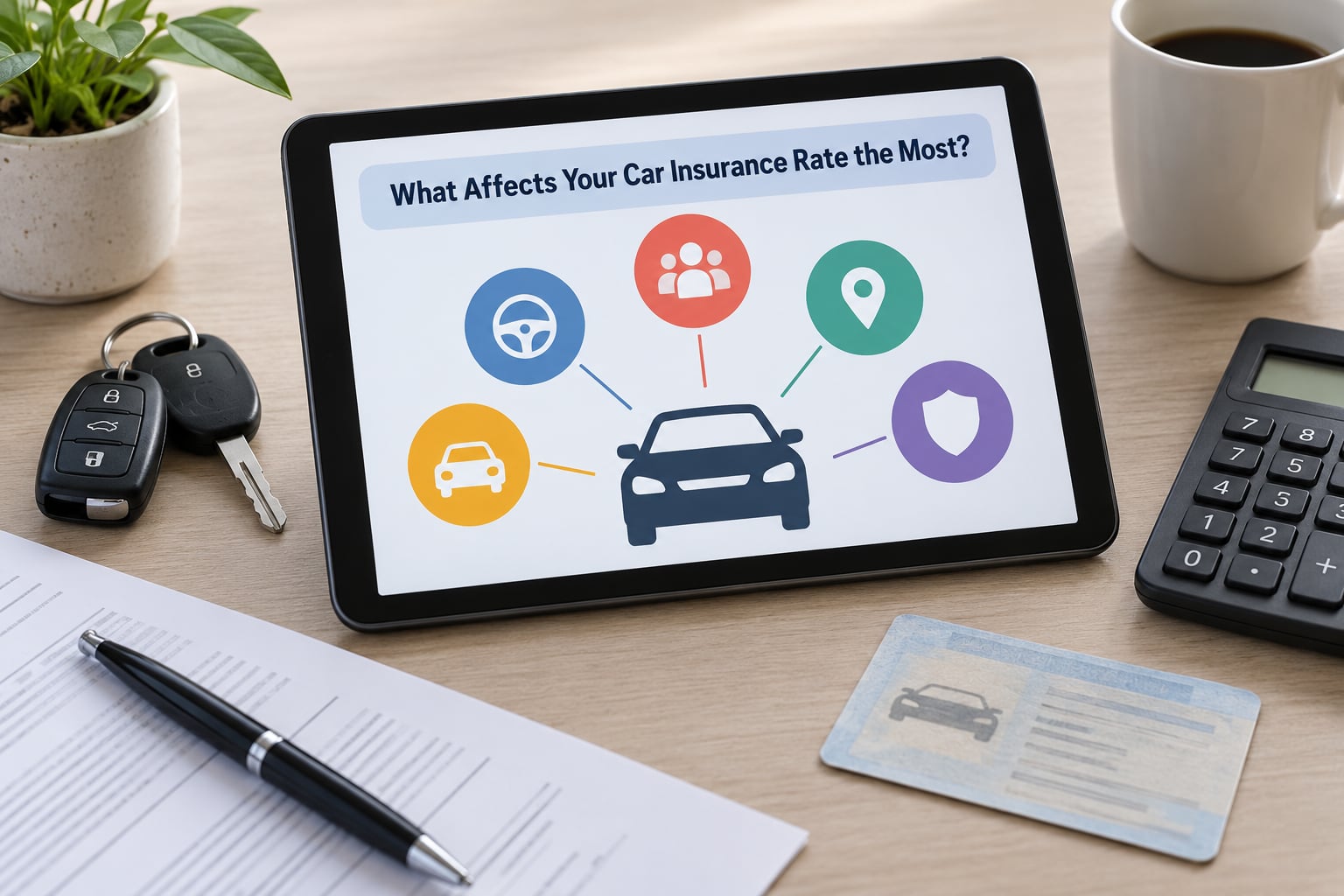
Your driving record and at-fault claims, the ZIP code and state where the car is garaged, the vehicle you drive, the coverage limits and deductible you select, and personal factors such as age, marital status and a credit-based insurance score are the main inputs to your premium. Claims history and location usually carry the heaviest weight.
Ranked by how much they typically move a US premium, the top five are:
- Your loss history. At-fault accidents and the claims attached to them are the single most expensive thing on your file.
- Where the car is parked. Your ZIP code is a proxy for traffic density, theft, weather, repair labour and medical costs.
- The coverage you buy. Limits, deductibles and add-ons are priced directly, so this is the one big lever you hold yourself.
- The vehicle itself. Make, model, year, safety kit and cost to repair drive the physical damage portion.
- Personal and credit factors. Age, driving experience, marital status, household composition and, where permitted, an insurance score.
Everything below expands on those five and separates the parts you can change from the parts you cannot.
How Insurers Calculate Your Premium
Insurers do not price risk by instinct. They build an underwriting file, score each variable, and multiply the result together into one annual premium divided by twelve.
The Insurance Information Institute describes the standard process this way: the company checks your application and driving record, rates the vehicle, applies territory and coverage factors, and then adjusts the base rate by the discounts and surcharges that apply to you. In practice that means a dozen or so inputs stack on top of each other, and no single one is the whole story.
Three things about that system are worth holding onto. First, the weights are proprietary. One national carrier can be more mileage-sensitive than a regional mutual writing business in the same state, and two carriers can look at an identical file and disagree by several hundred dollars a year. Second, state law caps what carriers may use and how they may file, so the same driver crossing a state line can change price overnight. Third, the company re-rates your file at renewal using its current tables, not the ones that quoted you last year. That is one reason a clean-driver renewal can still go up.
Ask your agent for the rating variables on your quote, not just the total. Most will walk you through it, and a few will send a written explanation of a change if you request one. The Insurance Information Institute and your state department of insurance are both good places to check how the system is supposed to work.
Your Driving and Claims History
At-fault claims are the factor that pushes a premium hardest, because a claim tells an underwriter exactly what you will cost if it happens again.
Moving violations matter too, in rough order of severity. A speeding ticket is a mark, a failure to yield or a red light is a bigger mark, and a DUI or DWI is a different category entirely, since it triggers a filing requirement such as an SR-22 or FR-44 certificate in many states. Every carrier treats these differently, which is exactly why the same ticket produces wildly different quotes.
The part that angers people most is the not-at-fault claim. Most carriers keep loss history whether or not the fault was yours, and there is no single rule across the industry. A few offer accident forgiveness, which credits one first claim, and some discount not-at-fault losses less heavily than at-fault ones. Nobody is required to tell you in advance, so ask before you file.
How long an incident follows you also varies by state and carrier. Treat these as typical ranges, not rules.
| Incident | Typical effect on premium | How long it tends to stay on record |
|---|---|---|
| At-fault accident with injuries | Largest increase of any single event | Often 3 to 5 years, sometimes longer |
| At-fault property damage claim | Meaningful increase | Typically 2 to 3 years |
| Not-at-fault claim on your policy | Smaller increase, carrier dependent | Usually 1 to 3 years |
| Speeding or minor moving violation | Modest increase | Commonly 1 to 3 years |
| Serious violation such as DUI | Very large increase or non-renewal | Often 5 to 10 years |
| Coverage lapse | Sharp increase, or no quote at all | Varies; treated as a serious risk signal |
Forum threads on r/Car_Insurance_Help and r/Insurance return to the same complaint repeatedly: nobody will explain the math, so a claim feels like a life sentence. It is usually shorter than people assume, but only if you ask your carrier directly how long their surcharge runs. A coverage lapse is the item to guard against at all costs, because it is the one that can follow you into your next quote.
Where You Drive and Park
Your address is not a formality. Insurers group ZIP codes and counties into territories and price each one on expected claim cost.
A dense urban ZIP carries more collisions per mile, more theft, more pedestrian and intersection exposure, and higher repair labour than a rural one ten miles away. A coastal or storm-exposed territory gets priced for weather losses. Some ZIP codes are priced harder simply because a small number of expensive claims landed there, which is why moving even a short distance can change your quote materially.
Two costs drive most of the territory gap: what a crash costs to repair in that area, and what medical treatment costs there. Both vary enormously by market. The spread is not subtle. Bankrate data cited by CNBC Select put Florida’s average annual premium at roughly 3,945 dollars against about 1,353 dollars in Vermont, with most states sitting somewhere between.
What you drive and where you park it is one question, not two. A high-theft model parked in a busy city is a different risk than the same car in a rural garage, and the two multiply.
What You Drive
Vehicle cost to repair, not sticker price, is what drives the physical damage half of your premium.
Insurers build cost-to-repair tables from parts prices, labour rates, body panel availability and how often a model shows up in claims. A mid-size German sedan with expensive panels and lamp housings costs more to insure than a similarly priced domestic sedan with cheap parts. Progressive puts it plainly: models with lower safety ratings, higher repair costs and more claims carry higher rates.
Age cuts both ways, which surprises buyers. An older car has less to replace, and that lowers cost. It also has more theft exposure, thinner safety features on some trims, and worse parts availability once a model leaves the market, and any of those can push the rate back up. Electric vehicles add their own line: body panels are expensive, glass and battery packs are pricey, and repair networks are still uneven by region. Forum readers report the same pattern repeatedly, one new-car purchase in years doubling a long-standing premium, and the vehicle, not the driver, causing it.
Actual cash value, the payout on a total theft or write-off after depreciation, is set by the same tables. Keeping a gap between the car you drive and the most similar replacement on the market tells an insurer how exposed that car is to theft and to a shrinking parts supply.
Annual mileage is usually the smallest factor people expect and one insurers still use. Cutting a genuine 15,000-mile commute to 6,000 is worth a real discount; a badge in the window is worth nothing. Weight in the vehicle rating also comes from the safety kit, so a newer trim with automatic emergency braking, lane keeping and a strong crash rating can quietly offset an otherwise expensive-to-repair model.
What You Buy and How Much Deductible You Choose
Coverage is the one large factor that is purely a decision, and it is priced in plain arithmetic rather than by table.
Liability limits are the cheapest part of a policy to add and the most expensive thing to run out of, because liability pays for injury damage you cause, and medical costs are the part of a claim that inflates fastest. Personal injury protection and medical payments are state-dependent requirements rather than options. Collision and comprehensive cover your own car, and uninsured motorist protection covers an at-fault driver who carries none, which regulators push hard because of exactly that scenario. Rental reimbursement, roadside assistance, gap coverage and accident forgiveness are priced as small endorsements, usually in the low tens of dollars a year each.
Deductibles work the other way. You keep the premium and you take the first slice of any covered claim.
| Collision deductible | Typical effect on premium | What you pay on a covered collision |
|---|---|---|
| 250 dollars | Baseline for most policies | The first 250 dollars |
| 500 dollars | Slightly lower | The first 500 dollars |
| 1,000 dollars | Often 10 to 20 percent below a 250-dollar deductible | The first 1,000 dollars |
| 2,000 dollars | Noticeably lower again | The first 2,000 dollars |
The arithmetic is the point. A 2,000-dollar deductible on a vehicle worth 3,000 dollars means you are carrying collision on a car you cannot afford to have repaired, and the premium you save is real money. That is the same logic behind dropping collision entirely once a car is worth less than the deductible plus a year of premiums. Do the reverse check too: if a fender bender would be a genuine financial problem at your deductible, the number is set too high for your situation, whatever the math says.
How Your Credit-Based Insurance Score Can Matter
Most large carriers now pull a credit-based insurance score, a three-digit number built from credit history rather than driving data, and use it as one rating variable. It is not your FICO score and it is not a judgment about how well you drive.
The inputs are payment history, outstanding debt, credit utilisation, length of credit history and new credit. Where permitted, insurers weight it meaningfully: analysis from The Zebra covering 2011 to 2021 data, cited by CNBC Select, found drivers scoring below 580 paid roughly 69 percent more than those above 800.
Eight states restrict or prohibit its use in auto pricing: California, Hawaii, Maryland, Massachusetts, Michigan, Nevada, Oregon and Utah. Rules shift with legislation, so confirm the current position with your state department of insurance rather than trusting a list, including this one. Most of the remaining states allow it, some with limits on how heavily it can weigh, and a handful of states restrict rating by gender or marital status in their own ways.
You can check it. Most carriers show the score in your online account or will give it to you on request, and major credit bureaus let you dispute inaccurate entries. Fixing a genuinely wrong delinquency helps everywhere, including with your insurer. Trying to game a ratio the insurer weighs differently from a lender is a waste of a Saturday.
How Much Does What Affects Your Car Insurance Rate the Most?
This is the ranked view, with the honest caveat that the order shifts by state, carrier and driver. Treat the influence column as a pattern, not a formula.
| Rating factor | Typical influence on the premium | Can you change it? |
|---|---|---|
| At-fault claims and loss history | Very high | Only forward, one accident at a time |
| ZIP code and state | Very high | Rarely, and moving costs more than the saving |
| Coverage limits and deductibles | High, and priced transparently | Yes, at any time |
| Vehicle cost to repair and value | High on the physical damage half | Yes, through your next purchase |
| Moving violations | Moderate to high | Only by driving clean from here |
| Age and driving experience | Moderate, and non-linear | No |
| Credit-based insurance score | Moderate, and barred in eight states | Slowly, if there is something to fix |
| Household and driver count | Moderate | Yes, though coverage never drops below real risk |
| Annual mileage and driving pattern | Small to moderate | Yes, if it is genuine |
| Discounts and surcharges | Small but free money | Yes, if you ask |
The pattern holds across the industry. Claims and territory carry the most weight, coverage and vehicle sit close behind, and demographics adjust the result. The Insurance Information Institute publishes the same broad grouping, and it is a fair description of how underwriters actually talk about a file.
Which Factors Can You Change?
Sorting the list into fixed and movable is the most useful thing you can do with it.
Fixed, for practical purposes, are your age, driving history, claims history, ZIP code, credit history and the car you already own. You can improve your record over time and you can correct a credit error, but you cannot argue any of them away this month. These are also the factors most likely to be weighted heavily, which is an uncomfortable combination and the honest reason people feel stuck.
Movable are your coverage choices, deductible, vehicle selection, driver list, discounts, and which carrier underwrites you. Every one of those is a decision you can revisit at renewal, and none of them requires changing who you are.
Worth naming, because the myth is common in forums: the colour of your car, how old you are beyond the point insurers treat as a rating variable, and whether you shop at one carrier or three do not matter on their own. What moves the number is the measurable stuff: losses, exposure, cost of repair, cost of medical care, and the coverage you elected to carry.
That split explains the recurring advice in forums like r/personalfinance to shop at every renewal. The same driver, the same car, the same ZIP code, priced by two carriers, can be a few hundred dollars apart because the two weight and discount the fixed variables differently. The fixed part of your file does not move. The variable part moves constantly.
Ways to Lower Your Rate Without Staying Uninsured
These are ordered by how much they typically return for the effort.
- Quote three to five carriers, apples to apples. Same limits, same deductible, same coverage set. Start about 30 days before your renewal date, which is also when most carriers are running their cheapest pricing. J.D. Power’s US Insurance Shopping Study found shoppers who compared quotes did better on both price and satisfaction.
- Match your coverage to the car and your savings. Review limits annually, and drop collision and comprehensive on a vehicle worth less than your deductible plus a year of premiums.
- Adjust the deductible deliberately. Raising it lowers the premium, but only take that trade if a full deductible payment would not wreck you.
- Ask for the discount list out loud. Bundling with home or renters, good student, mature driver, multi-car, low mileage, automatic payments, and a driving education or safety course. A MarketWatch survey of 1,000 drivers found 51.3 percent held auto alongside another policy. The discount list is longer than most people realise, and some apply without you asking.
- Look honestly at usage-based insurance. Pay-per-mile and telematics programs can help genuine low-mileage drivers. They also watch hard braking and late-night driving, and drivers posting on Reddit report city commuters being flagged for the traffic around them. Read what the app measures before you enrol.
- Keep the record clean and the policy paid. Do not let a policy lapse, and pay on time if your carrier offers an instalment or autopay discount.
- Re-shop when your situation changes. A new car, a new address, a new driver in the household, or a new job with a shorter commute all change the file, and you are entitled to a fresh quote at any time.
Before you file anything, ask how the carrier treats not-at-fault claims and how long a surcharge runs. The fear of filing is the single biggest reason people carry claims they should not, and that decision ends up costing them every year.
Why Two Drivers Can Get Different Quotes
Take two drivers with the same car, the same ZIP code, the same coverage limits, and clean records. The first is 34, has never filed a claim, and lives with a partner. The second is 61, has one three-year-old at-fault property damage claim, drives 30,000 miles a year for work, and pays everything online.
A carrier that weights mileage heavily and gives a low mature-driver credit will land on the first driver. A carrier that weights loss history steeply and discounts the second’s low-mileage-in-town pattern will land on the second. A third carrier, which requires its own bundled home policy to give its best auto rate, may price both higher and still come out cheapest for the first.
That is the whole explanation, and it is why the answer to a surprising quote is never argument. It is another quote. Insurers publish their rating factors selectively, weight them by their own loss experience, and refresh the weights as claims come in. The difference between two quotes is not an error in either one.
Frequently Asked Questions
What is the biggest factor in car insurance rates?
At-fault claims history and the territory where you park are usually the two heaviest inputs. Insurers price on expected loss: how often people in your ZIP code crash, how much those crashes cost to repair and treat, and whether you have filed before. Coverage choices and the vehicle itself sit close behind, and factors like age and insurance score adjust the result.
Does car insurance go up after a claim even if the accident was not my fault?
Usually yes, if the claim is filed on your policy. Most carriers keep loss history regardless of fault, so a not-at-fault claim can still count, though typically at a smaller weight than an at-fault loss. A few carriers offer accident forgiveness, which credits one first claim. Ask your insurer how they treat not-at-fault claims before you file.
How much can a car insurance rate change with a different deductible?
Moving from a 250-dollar to a 1,000-dollar collision deductible typically cuts the collision portion of a premium by roughly 10 to 20 percent, and a 2,000-dollar deductible saves more. The trade is exposure, since you pay the first 1,000 dollars of a covered claim. The size of the change depends on your vehicle, ZIP code and limits, so quote the same deductible across carriers.
Why did my car insurance quote increase when my vehicle is older?
Age itself usually lowers the cost to repair, but older vehicles raise other risks: more theft exposure, pricier parts as a model leaves the market, and fewer safety features on some trims. A large gap between the car’s actual cash value and the cost of a comparable used one also signals theft or repair risk. Check the declared value before you accept the quote.
Can insurers use my credit score in every state?
No. California, Hawaii, Maryland, Massachusetts, Michigan, Nevada, Oregon and Utah restrict or prohibit using a credit-based insurance score to price auto policies. Most other states allow it, and some limit how heavily it can weigh. Rules change with legislation, so confirm the current position with your state department of insurance rather than relying on any article, including this one.
Conclusion
Start with your own file. Pull the loss history and violations the carrier is using, and ask how long each item stays on record. Then check that the vehicle description and coverage limits on the quote match what you actually drive and need, because errors in either one are common and they skew the price.
After that, the part that affects what affects your car insurance rate the most is the decision half: your limits, your deductible, your driver list and which carrier writes the policy. Get three quotes with identical limits and deductibles, roughly 30 days out from renewal, and compare them line by line. Everything else on the list is either fixed or slow to move.