The short answer is that a store sign can take up anywhere from a small decal to the entire printable area of a window, and the number that actually matters is the glass area you are working with plus the clear space and safety zones you need to keep. Physically, coverage can reach 100% of a pane. Practically, most shops settle somewhere between a quarter and three-quarters of the glass, because that is the point where a customer can still see the counter, the door and the sidewalk.
Most people get stuck because they think about coverage as a single number on a sign shop’s price list. It isn’t. It is a relationship between the sign, the glass, and the rules that apply to that specific building in that specific city, updated as of October 2026.
Table of Contents
- What Does Window Coverage Mean?
- How Much Window Coverage Can a Store Sign Have?
- Window Coverage at a Glance
- How to Calculate the Maximum Sign Area
- What Coverage Works Best for Visibility?
- Which Sign Materials and Installation Methods Work Best?
- What Safety and Property Rules Should You Check?
- Frequently Asked Questions
- Can window signage cover 100% of a storefront window?
- Is it legal to cover an entire store window with vinyl?
- How much clear space should be kept around a window sign?
- Will full-window vinyl reduce natural light and visibility?
- Can window graphics be removed without damaging the glass?
- What to Do First
What Does Window Coverage Mean?
Window coverage is the portion of a window’s glass area that is given over to signage, whether that is cut vinyl lettering, a printed film wrap, a frosted privacy panel or a perforated window graphic. Coverage is not the same thing as sign size. A sign can be physically large and still count as a small percentage of coverage, or it can be narrow and tall and cover a surprising amount of glass.
The distinction that matters most for planning is between the total area of the sign and the area of the window. A 3-foot-wide banner across an 8-foot window looks modest, but if it runs the full 5-foot height of the glass it is covering a large share of everything a passerby can see.
How Much Window Coverage Can a Store Sign Have?
How much window coverage can a store sign have? It can span the full printable area of the glass, but the usable design area is normally the glass width and height minus edges, frame, mullions, door hardware, obstructions and any required clear space. Most working storefronts land between 25% and 60% coverage.
That is the technical ceiling. The practical one comes from three other sources that sit on top of the glass area: sightlines people need to see into the shop, rules from whoever owns the building, and any local sign ordinance written in percentage terms.
Window Coverage at a Glance
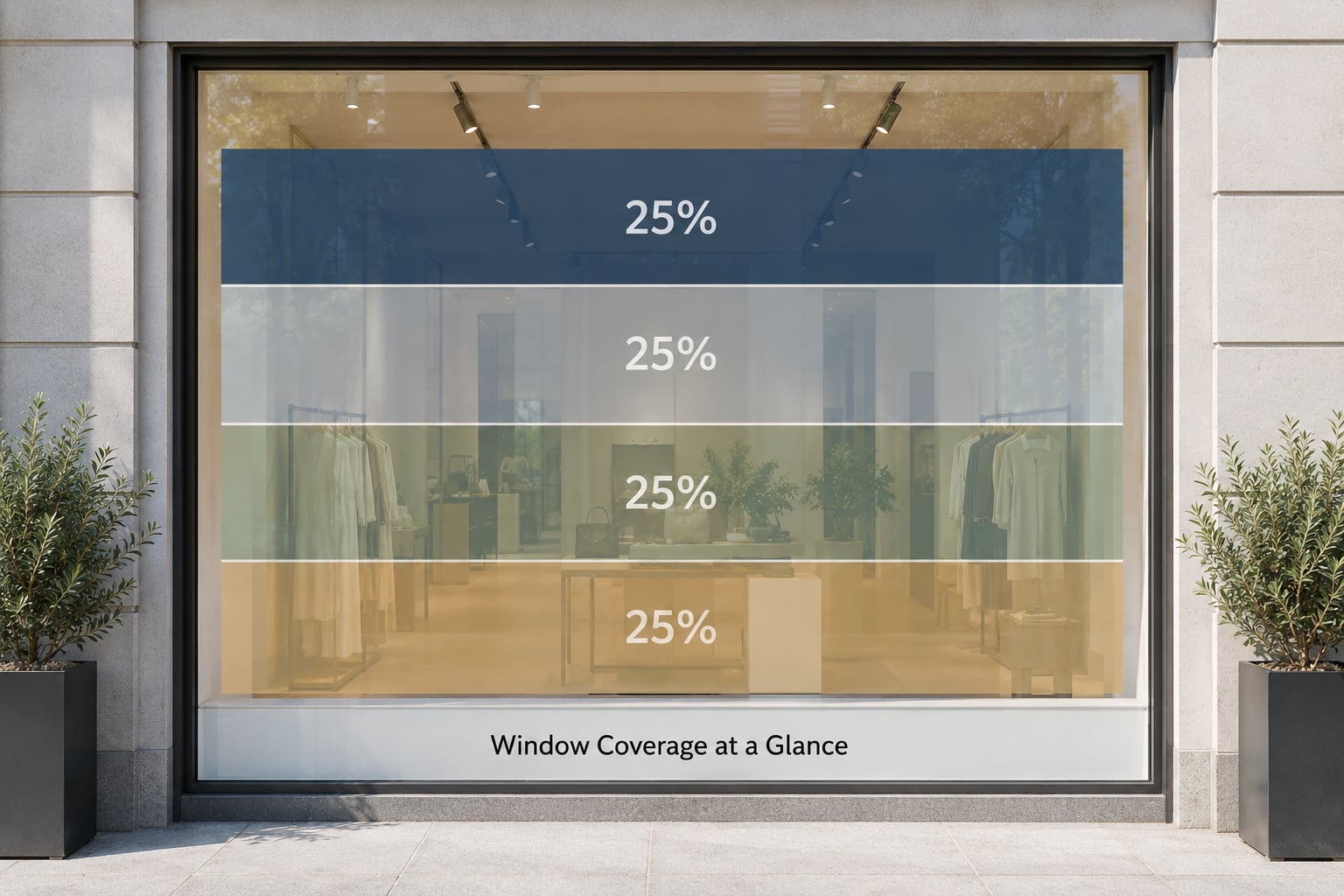
The percentages below describe how much of the glass carries signage, not how big the sign is in inches. Use them as a starting point for the conversation with your property owner and your local authority.
| Coverage level | Share of glass | Typical use | Effect on visibility | Best fit |
|---|---|---|---|---|
| Partial | Under 20% | Hours, phone number, small logo, QR code | Shop interior and sidewalk stay fully visible | Sidewalk-facing retail where passersby need to see inside |
| Moderate | 20% to 40% | Store name, key message, service list | Interior still readable in daylight | Most small storefronts on a main street |
| High | 40% to 70% | Seasonal campaign, grand opening, full brand moment | Interior partly screened; counter area must stay clear | Corner units and drive-by traffic |
| Maximum | 70% to 100% | Privacy film, wraparound graphic, holiday display | Natural light and outside views drop sharply | Offices, clinics and upper-floor interiors |
Two practical notes on the table. First, the same coverage level reads very differently depending on how dark or opaque the film is: a pale frosted band and a solid black wrap can occupy identical area and behave nothing alike. Second, the percentages describe the finished look, not a legal allowance. Local rules and lease terms can be stricter than anything on this chart.
How to Calculate the Maximum Sign Area
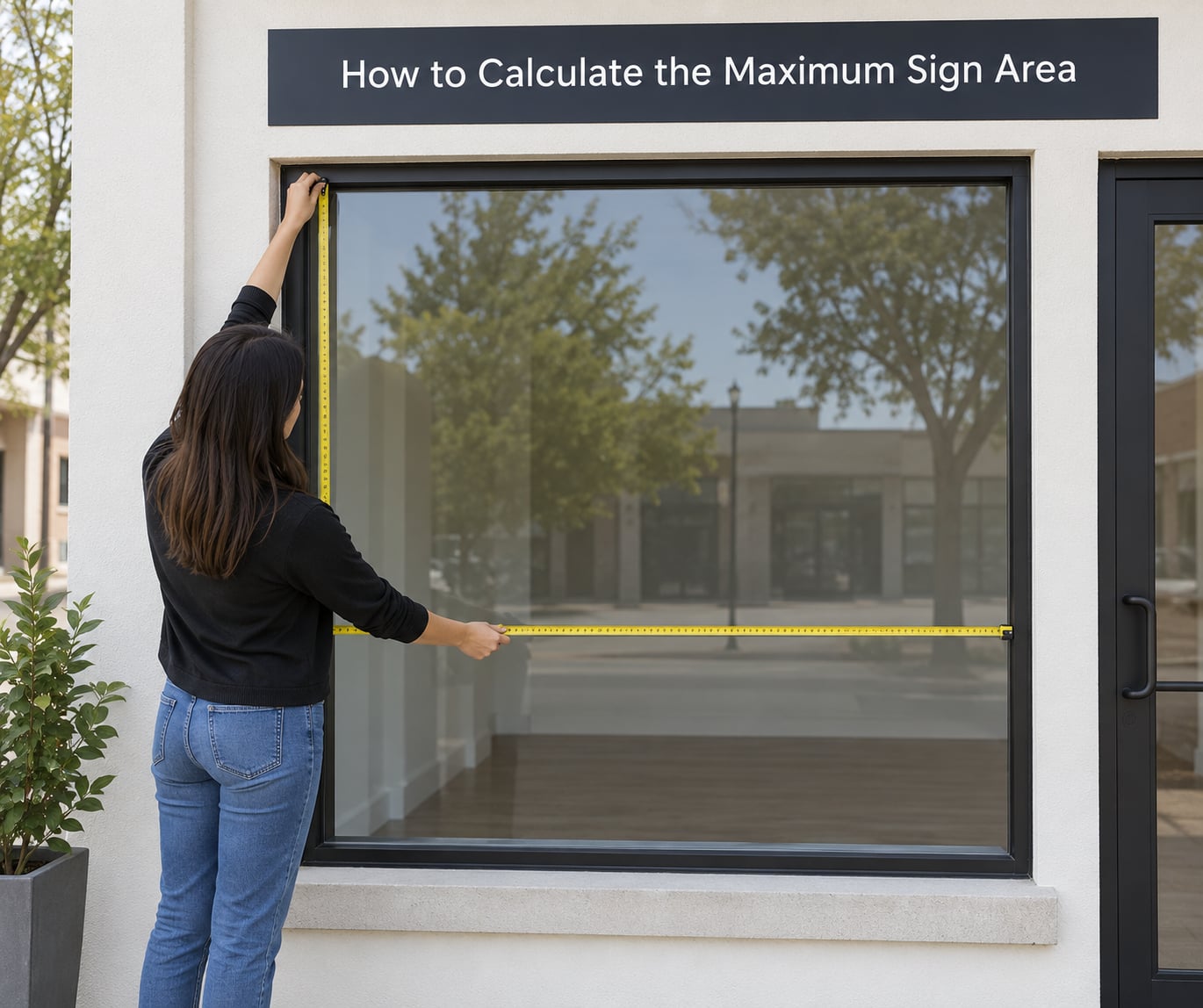
Calculate by area, not by width alone. Width and height on their own tell you nothing about how much glass you have actually consumed, and a percentage of a rectangle is the only figure most rules are written against.
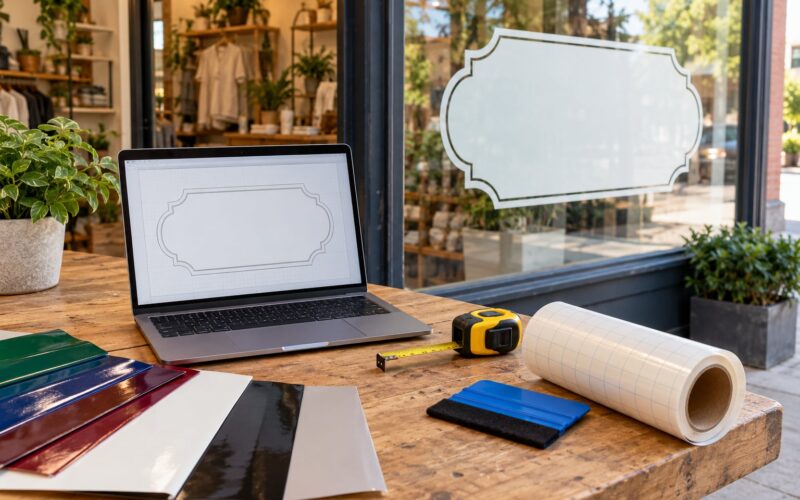
- Measure the glass, not the frame. Record the width and height of the visible pane at its widest and tallest points. For a large storefront, measure each pane separately if mullions split it.
- Multiply to get glass area. A window measuring 7.5 feet wide by 4.5 feet tall gives you 33.75 square feet of glass.
- Subtract fixed exclusions. Deduct frames, mullions, door hardware, vents, security grilles, transom lights and anything already permanently covered. Mark these on a sketch.
- Mark the clear and safety zones. Reserve an unobstructed band at eye level near the door, a clear route to the exit, and any area your property owner or local rules require to stay visible.
- Apply your percentage to the remaining area. If your usable glass is 33.75 square feet and you are working to a 40% target, your maximum sign area is 13.5 square feet. A 4-foot by 3.4-foot panel uses 13.6, so bring it down slightly.
- Record the numbers before you order. Write down the pane measurements, the exclusions and the percentage you used. That sheet is what you send to the property owner or take to a permit counter.
The worked example above is deliberately ordinary, because most storefront panes are ordinary. A 4-foot by 8-foot glass wall behaves the same way in the math: 32 square feet of glass, and your sign budget is whatever percentage of that your rules and your property owner allow.
Do the calculation per pane and per building face rather than averaging across the whole storefront. A percentage cap applied per window can leave you with a generous-looking total that still breaks the rule on one particular pane.
What Coverage Works Best for Visibility?
Match the coverage level to the message, then to how far away the reader is standing. A sign designed for a car at 40 feet has to be far simpler than one meant to be read at the door.
Store name and logo only. This is the most common case, and it wants partial coverage. Put the mark in the eye-level band so someone walking past can register it without the shop going dark behind them. A single line of lettering plus a logo usually lands well under a quarter of the glass.
Hours, phone and QR code. These need a small, fixed footprint, usually at the door or at the bottom corner of the pane. Place them where someone already has to stop, and keep the scannable area flat and untextured so a phone camera reads it in low light.
A product or service message. Here a moderate level works: enough area for the message to have weight, with the middle of the glass kept open so the products behind it still register. Keep the densest part of the graphic above or below the eye-level band rather than across it.
Privacy. Privacy is the one case where high to maximum coverage is the point. Frosted or etched-look film at the lower half and clear glass above gives you screening where you need it and daylight where you want it.
Where you are on the street changes the design too. Sidewalk traffic reads a window from close range and often from an angle, so crisp lettering beats large blocks of type. Parking-lot and drive-by traffic sees a foreshortened, moving image, which favors a bold simple message high enough to clear parked cars.
Which Sign Materials and Installation Methods Work Best?
Material choice decides how your coverage actually behaves in daylight, and how painful it is to change later.
Cut vinyl lettering. The most economical route to low coverage. It applies cleanly, removes without residue when the adhesive is managed properly, and can be re-lettered for a seasonal change without touching the glass.
Printed film. Lets you use photographs and full colour artwork, so the same area carries far more information than lettering. It is heavier on the eye and heavier on coverage, which means high-coverage printed wraps need a clearer plan for what stays visible behind them.
Perforated window film. A sheet with a regular pattern of tiny holes that lets light pass from the bright side to the dark side. From outside it reads as a solid graphic; from inside it stays translucent. This is the practical route to a visually full pane while keeping daylight and some interior visibility, and it is the material most likely to be looked at more favourably under a coverage rule than a fully opaque wrap.
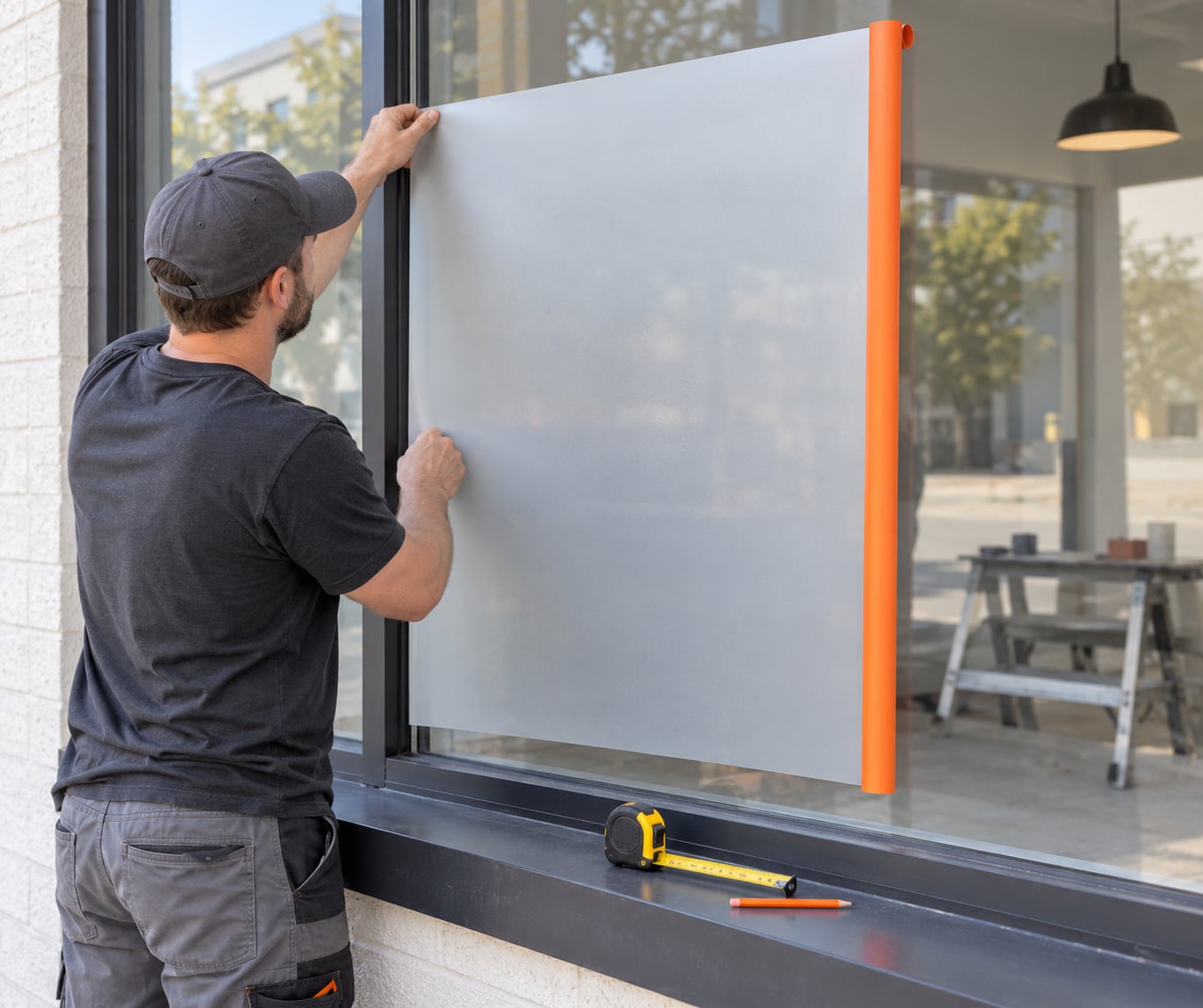
Frosted or translucent vinyl. A middle ground for privacy and branding at the same time. It filters light rather than blocking it, which makes it comfortable for staff who work behind it all day.
Static cling and removable decals. The right choice for short-term tenants, pop-up storefronts and seasonal campaigns where nothing should be left behind at the end of the run.
On installation, apply to the interior face if the message is meant to be read from the street, since that protects the graphic from weather and gives you a repairable surface. Applying to the exterior face keeps the view from inside cleaner. Either way, glass should be clean and room-temperature, and work in sections rather than one enormous sheet.
What Safety and Property Rules Should You Check?
Before you order film at any coverage level, three sets of rules need checking, and they stack. The most restrictive one wins.
Local sign ordinance. Many municipalities write a window signage cap as a percentage of glass area, with figures commonly landing at 10%, 20%, 25%, 30% or 40%. Some measure per window, some across a whole building face, and some include the glass in doors while others exclude it. A few also treat perforated or translucent film differently from opaque coverage. Find your city’s zoning or sign code through the planning department website or the sign permit page, and read the window provision rather than the general sign section.
Landlord, lease and centre rules. The owner of the building decides what goes on the glass. Many shopping centres and mixed-use developments have signage criteria that are stricter than the city code, and some specify translucent film only, a fixed logo placement, or no window signage at all. In one New Jersey town that capped window signage at 40% after residents complained about a shopping centre’s appearance, the town attorney was clear that the allowance was a ceiling rather than permission: the property owner still had to approve each window. Get that approval in writing before the print run.
Building and fire safety. Doors serving as emergency exits must remain operable and identifiable, and glazing rules may limit how film or signage affects a rated assembly. Large areas of dark film on tinted or low-emissivity glass can also raise heat in the pane in direct sun, which is worth asking about if you plan a high-coverage wrap on a west-facing window.
Historic districts add a review layer on top of everything else, since a change to a storefront’s appearance may need approval before any material is ordered.
When you cannot resolve a question from the code text itself, the fastest route is a short call to the planning or code enforcement office for your jurisdiction, with your measured pane dimensions and the percentage you calculated in front of you. If the answer matters commercially, ask for it in writing. For anything involving structural glazing, egress or a variance, go to a qualified sign professional rather than guessing.
Frequently Asked Questions
Can window signage cover 100% of a storefront window?
A full-pane graphic is physically possible and is common for privacy film, holiday wraps and grand openings. Whether it is permitted depends on your local sign ordinance, which often caps window signage at a percentage of glass area, and on your property owner’s signage criteria, which can be stricter. Perforated or translucent film usually gives a visually full pane while keeping daylight and interior visibility.
Is it legal to cover an entire store window with vinyl?
It depends entirely on where the building is. Many municipalities cap window signage at a set percentage of glass area, commonly between 10% and 40%, and measure it per window or per building face. Covering a whole pane without checking may breach that cap. Read your city sign code, then get written approval from the landlord or centre owner, before ordering a full wrap.
How much clear space should be kept around a window sign?
Keep an unobstructed band at eye level near the entrance, a clear route to any emergency exit, and the areas your property owner reserves. As a working habit, leave a margin of several inches on every edge of the pane so the glass still reads as glass, and never let signage creep into the swing path or the door hardware. Local sightline requests from police or fire departments can add further requirements.
Will full-window vinyl reduce natural light and visibility?
Opaque vinyl does, considerably, and that is often the point when the film is for privacy. Perforated window film is the compromise most shops choose: it reads as a solid graphic from the bright side and stays translucent from the darker interior, so staff keep daylight while customers see a complete design. Frosted or translucent vinyl softens light rather than blocking it and works well for clinics and offices.
Can window graphics be removed without damaging the glass?
Most pressure-sensitive window graphics come off cleanly when they are warmed, peeled at a shallow angle and removed steadily, and adhesive vinyl is generally considered removable rather than permanent. Films that have baked onto glass in direct sun, or residue left behind, can need a specialist cleaner. Ask your installer for the adhesive type and removal instructions before the job, and photograph the pane beforehand.
What to Do First
Measure the intended window and write down the pane dimensions, then mark every clear zone, door, obstruction and safety requirement before you design anything. Multiply the glass width by the height, subtract the exclusions, and apply the coverage percentage your local code and your property owner actually allow. Once you have that number, pick the coverage level that carries your message and still leaves the storefront usable in daylight.