Local marketing for a hair salon means the online and offline tactics that put you in front of people who live, work and shop within a few miles of your chairs. That means a complete Google Business Profile, local search visibility, reviews, neighborhood partnerships, signage, referrals and tightly geo-targeted ads. Everything else you try is a bonus on top of that.
This guide is written for independent and owner-operated salons: solo stylists, small teams and multi-chair shops in neighborhoods or small towns. Owners on salon and small business forums keep repeating the same constraint, so every idea below comes with an honest time and cost estimate. Most of these need an afternoon, not a marketing hire.
One distinction worth making early. General salon marketing tries to make you look good to anyone. Local marketing tries to make you the obvious choice for people within driving distance. That narrower target is why a few hundred dollars a month spent locally can outperform a much larger budget aimed at a wide audience.
Updated for 2026, and written to work whether you have five hundred dollars a month to spend or nothing at all.
Table of Contents
- 12 Local Marketing Ideas for a Hair Salon at a Glance
- How to choose between 12 local marketing ideas for a hair salon
- 1. Optimize Your Google Business Profile
- What to fill in first
- Keep the name, address and phone identical everywhere
- Add photos on a schedule, not a one-off
- 2. Create Service-Specific Google Posts
- 3. Build a Referral Program
- Make the offer fair to everyone involved
- Write the terms before you announce it
- 4. Use a Loyalty Program That Encourages Return Visits
- 5. Partner With Nearby Businesses
- Propose something small and specific
- 6. Promote Seasonal Hair and Treatment Specials
- 7. Encourage Clients to Share Local Experiences
- Ask at the right moment
- Stay on the right side of platform rules
- 8. Run Location-Targeted Social Media Campaigns
- 9. Host Local Events or Demonstrations
- 10. Improve the Salon’s Physical Visibility
- The three-minute street check
- 11. Create a Local Email and Text Reminder Campaign
- Segment by service, not by person
- Send updates worth opening
- 12. Ask Clients for Feedback and Local Reviews After Visits
- Frequently Asked Questions
- What is the easiest local marketing idea for a small hair salon?
- How much should a hair salon spend on local marketing?
- Which local marketing channel usually brings salon bookings?
- How can a salon encourage repeat visits without heavy discounts?
- How often should a hair salon post on social media?
- How can a salon measure whether local marketing is working?
- Conclusion: Start With One Easy Local Marketing Win
12 Local Marketing Ideas for a Hair Salon at a Glance
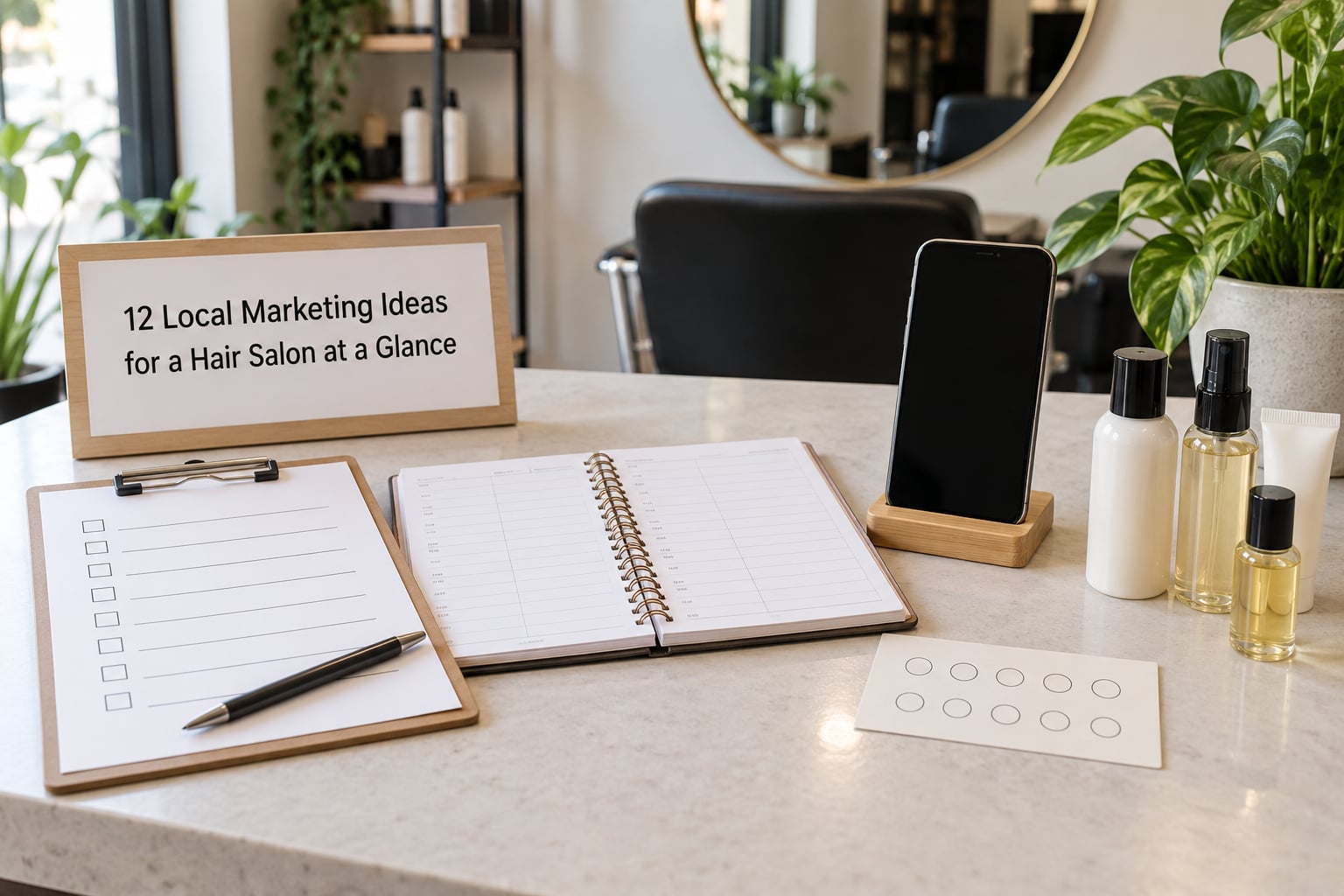
Here is the whole list on one page. Each row gives you the situation it works best in, what it actually delivers, and the smallest possible first step if you only have an hour.
| Idea | Best for | Main benefit | Simplest first step |
|---|---|---|---|
| 1. Google Business Profile | Every salon, start here | Shows up in map results for nearby searches | Add every real service name you actually offer |
| 2. Service-specific Google Posts | Chasing first-time clients | Fresh content for one service at a time | Write one post about your most-booked service |
| 3. Referral program | Salons with loyal regulars | Cheapest repeatable new clients | Write the offer terms in three sentences |
| 4. Loyalty program | Long gaps between visits | Turns one visit into a habit | Decide the reward and the visit count |
| 5. Nearby business partnerships | Town or neighborhood salons | Borrowed trust from a shared clientele | List ten businesses your clients already visit |
| 6. Seasonal specials | Slow weeks and quiet months | Fills chairs without permanent discounting | Map three calendar moments to services |
| 7. Client reviews and shared photos | Building local proof | More trust than any ad you can buy | Add a review request to your checkout message |
| 8. Location-targeted social ads | Salons ready to spend a little | Reach only people who can walk in | Target a five-mile radius on one post |
| 9. Local events and demos | Brand-new salons, thin client lists | Face-to-face trust in a small room | Run one 45-minute styling workshop |
| 10. Physical visibility | Walk-in and drive-by traffic | People who pass you can actually find you | Check your sign and hours from the street |
| 11. Email and text reminders | Protecting booked revenue | Fewer no-shows, more rebooking | Add a 24-hour reminder to every booking |
| 12. Post-visit feedback | Salons stuck guessing | Tells you which idea deserves more money | Send one two-question message after each visit |
How to choose between 12 local marketing ideas for a hair salon
Pick the row that matches your actual problem this month, not the one that sounds most interesting. If nobody can find you, start at row one. If you are full but nobody is coming back twice, start at row eleven. Trying all twelve at once is how salons end up with a half-finished profile, a referral offer nobody mentions and an event that flopped.
1. Optimize Your Google Business Profile
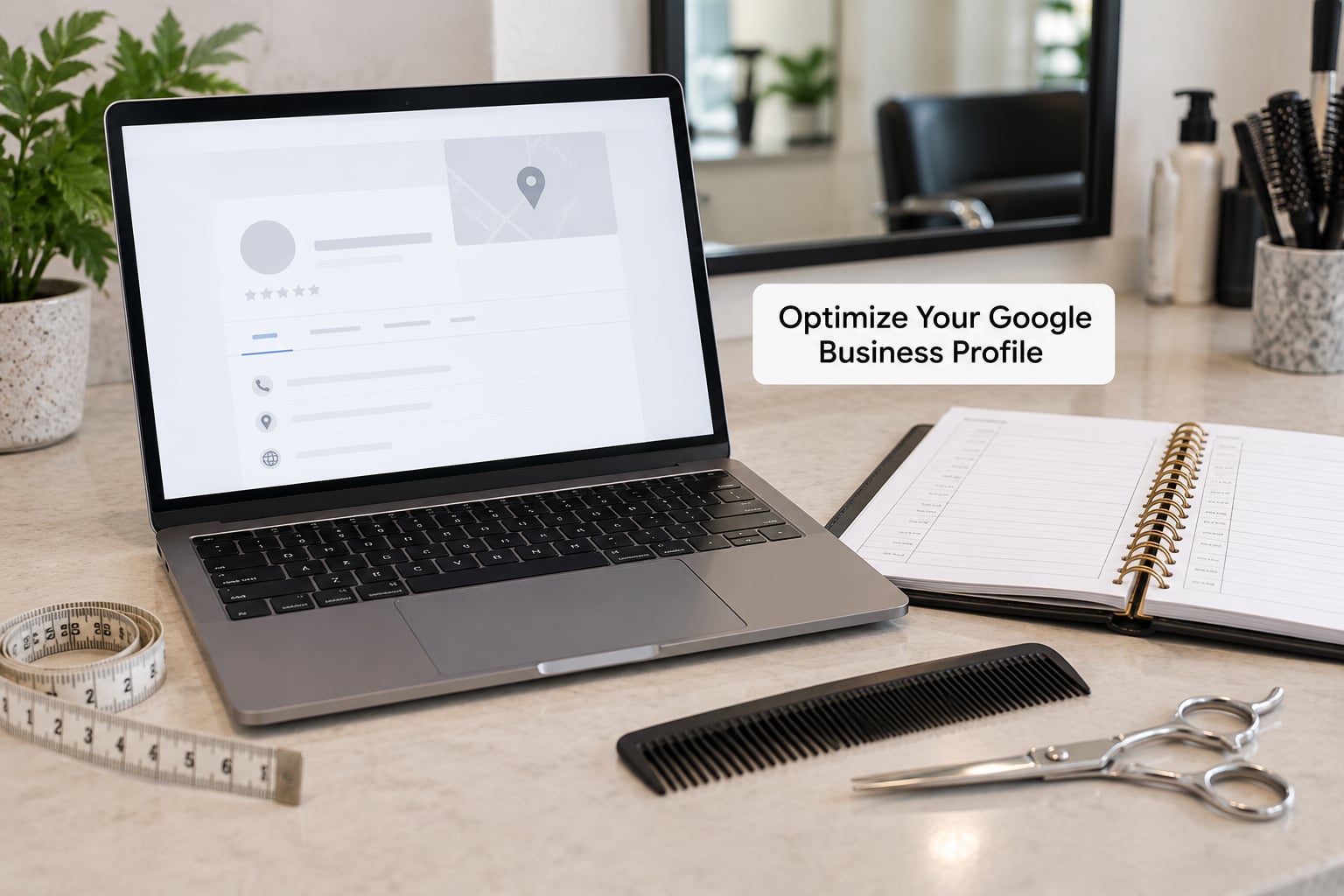
Your Google Business Profile is the listing that appears when someone nearby searches for a salon, a stylist or a specific service. Owners repeatedly say the same thing in forum threads: the fastest visible win is finishing the profile and using the real names of the services they actually perform. A listing that says “signature package” when a person searched “curly haircut” is invisible to that person.
What to fill in first
Work through the fields in this order, because each one feeds the next. Name, category, services with real descriptions, hours, service area, booking link, photos, and a short description written the way a neighbor would describe the place.
Keep the name, address and phone identical everywhere
Consistency across your website, social profiles and printed material matters more than people expect. When three different versions of your salon name exist online, search engines lose confidence about which is the real one. Pick one and never deviate from it again.
Add photos on a schedule, not a one-off
Upload a handful of current photos of the salon interior, the front of the building and recent work. Add a few more each month. Stale photos are one of the most common reasons a fully booked-looking salon still loses clicks to the shop two streets over.
Time cost: roughly three hours the first time, then fifteen minutes a month. This one idea underpins ideas two, seven and twelve, so do it before spending anything else.
2. Create Service-Specific Google Posts
Posts on your profile are short updates attached to your listing, and they let you talk about one service at a time instead of the salon as a whole. A post about what a balayage appointment actually involves, how long it takes and who it suits reaches people already searching for that word.
Keep the structure simple: the service name, one useful detail that answers a question a nervous client has, and one call to action. Mention the neighborhood or nearby area you serve, since that is the language local search reads. Post about one service a week, and never promote a service you are not actually taking that month.
Time cost: about thirty minutes per post. Owners with several staff often rotate this duty so the front desk is not stuck writing copy on top of everything else.
3. Build a Referral Program
Local partnerships and referrals are described over and over in owner discussions as the cheapest repeatable source of new clients, especially when the partner serves the same kind of client. The mechanism is easy; the discipline is in the terms.
Make the offer fair to everyone involved
Reward both sides. The existing client gets something on their next visit, the new client gets something on their first. Size the reward to what you would comfortably spend to win a stranger: a conditioning treatment or a small add-on service usually costs you retail value, not full price.
Write the terms before you announce it
Decide how the referral is claimed, how long it stays valid, and what happens if someone is referred twice. Then say the same three sentences to every client at checkout. A referral offer that lives only in the receptionist’s memory is not a program.
Track it in the simplest way possible: a note in the booking record when the appointment came from a referral. That single field tells you within a month whether this idea deserves real money.
4. Use a Loyalty Program That Encourages Return Visits
Color clients drift between appointments for months and then quietly disappear. A simple punch card fixes that without training anyone to wait for a discount. Hand the card over at checkout, stamp it after each visit, and write the reward rule on the card itself.
Tie the reward to visits rather than spend, because spend-based systems invite awkward conversations at the desk. Six stamps for something free is easier to understand than a points formula. Make sure the reward costs you less than the extra visits are worth, and check that figure against your own numbers before printing anything.
A digital version on your phone works too, but a physical card still sits in a client’s purse and reminds them you exist. For many salons that reminder is the entire mechanism.
5. Partner With Nearby Businesses
List ten businesses your clients already walk into: bridal shops, photographers, spas, boutiques, event planners, gyms, dance studios, florists, dry cleaners. The right partner serves the same person you serve. A bridal boutique and a salon on the same street is an almost unfair advantage, because both of you are talking to the same weekend.
Propose something small and specific
Cross-promotions work best as card handouts or shared posts rather than formal co-branded campaigns. Try one of these: a card at their register with your services listed, a mention in their newsletter or social post, a small event where each of you brings five clients. Keep it to something you can run in an afternoon.
Give it a date and a name. Partnerships with no end date are the ones that quietly die after the initial enthusiasm. Check in once a month with a two-line message and one idea for the next month.
6. Promote Seasonal Hair and Treatment Specials
Salons have a rhythm. Summers and the stretch after the holidays are usually quieter, and wedding seasons pull hard in the other direction. Mapping your promotions to that rhythm means you fill slow chairs without cutting prices on your busiest week of the year.
Build the calendar from three or four moments you already know: graduation season, wedding dates, holiday styling, the first hot week, school breaks. Attach one service to each moment rather than running a permanent discount. A summer conditioning treatment add-on during your slowest month does the same job as a sale and costs you less margin.
Skip vague claims. Promising a result you cannot describe precisely invites awkward conversations at the chair and disappointing reviews later.
7. Encourage Clients to Share Local Experiences
Reviews that mention a specific stylist and a specific service reportedly drive more new bookings than generic praise, because they answer the exact question a new client is asking. You cannot script a review and you should not try.
Ask at the right moment
The request works best when the client is at the desk, happy and not yet in a hurry, and it works best if you hand them the link on a phone or a card rather than describing where to find it. One clear ask per satisfied client beats a reminder taped to the mirror.
Stay on the right side of platform rules
Never buy reviews, never offer a reward for a review, and never trade one for another. Review platforms and search engines all treat those as manipulation, and the penalty can cost more than the reviews were worth. If you run a reward program, reward referrals, visits and feedback, not public ratings.
Ask every client, not only the ones who praise you, and answer every review including the difficult ones. A thoughtful reply to a bad review does more for local trust than the review itself.
8. Run Location-Targeted Social Media Campaigns
Organic social posts and paid local ads are different tools. Posting transformation photos builds a portfolio that sells itself later. A small radius-targeted ad fills tomorrow’s slow slot this afternoon. Owners with a tight budget usually get more from the first, then test the second with a small daily cap.
Keep the targeting radius tight, roughly the distance most of your clients will actually travel. Show the work, show the room, show how to book. Use a handful of relevant local tags instead of a wall of generic ones, and link the post straight to a booking page rather than the home page.
Measure three things only: calls, direction requests and completed bookings. Likes are not a salon metric. If you cannot tie a campaign to one of those three numbers, keep the budget small and move on.
9. Host Local Events or Demonstrations
A small in-salon session does something no post can: it lets a stranger watch your stylist work up close. Product demonstrations, styling workshops, seasonal consultations and seasonal hair-care evenings all work. Forty-five minutes is plenty. Eight to twelve people is plenty.
Promote it through your profile, your existing clients and your local partners rather than paying for reach. Collect a simple sign-up with name, phone and service interest, then follow up within a week. That list is worth more than the evening’s revenue.
Charge a modest amount or take a deposit. A free event fills the room with people who will never book, and the deposit filters for the ones who mean it.
10. Improve the Salon’s Physical Visibility
People drive past and walk past you constantly. Most of them never look up because they could not tell what the place is, when it is open, or where the entrance is. Stand on the sidewalk as if you were a potential client and check the same three things.
The three-minute street check
Can you tell what the business is from the sign? Are the hours readable from the pavement? Is the entrance obvious at dusk? Fixing any of those three is cheaper than any advertising you will buy this year.
Window lighting, an exterior hours decal and a clear address on the listing all help the person who is already close. For anything mounted, drilled or rewired, hire a professional installer rather than a well-meaning weekend helper.
Add a small sign or menu in the window showing today’s openings. It converts passing traffic into booked appointments without a single ad.
11. Create a Local Email and Text Reminder Campaign
Automation is repeatedly described in owner forums as the highest-return “marketing” work a salon can do, because it protects revenue you already have rather than chasing new clients. A 24-hour reminder and a two-hour reminder cut no-shows. A rebooking prompt at the natural interval for each service brings lapsed clients back.
Segment by service, not by person
A color client needs a touch-up nudge at eight weeks. A blow-dry client is back in three. One message sent to your whole list is how you end up unsubscribed. Group by service interval and send to each group on its own schedule.
Send updates worth opening
Useful messages are availability changes, holiday hours, a stylist’s schedule, a seasonal service and a booking link. Promotions belong at the bottom of that list. Frequency matters more than length: two messages a month to a segment that has not opted in is how permission gets revoked.
Only message people who gave you permission and who can reply STOP. Treat that list as an asset you are borrowing, not one you own.
12. Ask Clients for Feedback and Local Reviews After Visits
A short follow-up after each visit tells you two things: where the experience is strong, and where it is quietly failing. Two questions is enough. Which service did you have, and how would you rate the visit? Add a free-text box and read the answers every week.
When feedback is positive, that is your moment to ask for a public review using the wording from idea seven. When it is negative, respond personally, fix the cause and check whether it keeps appearing. One recurring comment about waiting times is more valuable than a month of ad data.
Over time, feedback tells you which of these twelve ideas deserves more money. Track it against the questions you actually care about:
| What you track | The business question it answers |
|---|---|
| Calls and direction requests | Are nearby people finding the listing? |
| Completed bookings by source | Which idea actually produces appointments? |
| No-show rate | Are reminders protecting chair time? |
| Rebooking rate by service | Are clients coming back on schedule? |
| New clients from referrals | Is word of mouth compounding? |
| Spend per new client | Which channel deserves the next dollar? |
Review these numbers once a month, not daily. Daily checking produces anxious decisions based on noise, and noise is what pushes owners into tactics they cannot sustain.
Frequently Asked Questions
What is the easiest local marketing idea for a small hair salon?
Finishing your Google Business profile. It costs nothing, takes about three hours the first time, and it is the listing that appears when someone nearby searches for a salon or a specific service. Add the real names of the services you actually offer, correct hours, a booking link and a few recent photos. Most salons in this situation already have a listing they have never edited.
How much should a hair salon spend on local marketing?
For a small independent salon, a realistic range is a few hundred dollars a month, and plenty of salons run the first three or four ideas in this guide at no cost at all. Put the money into photo work, printing, a location-targeted ad with a small daily cap, and occasional events. Many owners report that automating reminders protects more revenue than an advertising budget of the same size.
Which local marketing channel usually brings salon bookings?
For most independent salons the order is predictable: referrals and word of mouth first, then the Google Business profile and reviews, then location-targeted ads. Paid ads accelerate what already works rather than creating demand on their own, so owners usually get better results after the profile, reviews and booking path are solid. Track completed bookings by source and let your own numbers settle the argument.
How can a salon encourage repeat visits without heavy discounts?
Schedule the next visit before the client leaves, and book it against the natural interval for the service they just had. Add a punch card tied to visit count rather than spend, since visit-based rewards are easier to understand and cheaper to run. A reminder sent near that expected return date does more than a discount, and it protects your margin at the same time.
How often should a hair salon post on social media?
Three posts a week is a realistic pace for a small salon that also runs the chair: one transformation, one salon view, and one useful tip or behind-the-scenes moment. Quality matters more than volume, and mixing in client photos with permission keeps the feed from looking like an advertisement. If you can only manage two posts a week, keep those two consistent rather than posting five once a month.
How can a salon measure whether local marketing is working?
Track six numbers monthly: calls and direction requests, completed bookings by source, no-show rate, rebooking rate by service, new clients from referrals, and spend per new client. Ask for a source when a new client books, even if it is just a checkbox at the desk. Read the numbers once a month and give the next dollar to whichever idea produced the most completed bookings.
Conclusion: Start With One Easy Local Marketing Win
Finish the Google Business profile this week, using the real names of the services you actually offer. Choose one repeatable mechanism next, either a referral offer or a visit-based punch card, and write its terms down so the whole team says the same thing.
Then track calls and completed bookings for thirty days before spending on anything else. These local marketing ideas for a hair salon get easier, not harder, once you know which two are producing the appointments. Add the third idea only when the first two are boringly predictable.