Branding a mobile service business means deciding who you serve, what makes you different from the other two vans on the block, and how you look, sound, and show up — on the vehicle, on your uniform, on your Google Business Profile, and at the customer’s back door. Because you have no storefront, the brand does the convincing for you. This guide walks the whole process in seven steps: define your service area and ideal customer, write a short brand promise, build a consistent visual identity, design vehicle graphics that read at speed, match every customer touchpoint, promote the brand locally, then measure booked jobs and improve.
It is mostly strategy, which you can do in a couple of evenings, plus a modest first round of materials you order once the strategy is settled. Skip the strategy and you end up with a nice logo that nobody recognizes.
Table of Contents
- What You Need to Brand a Mobile Service Business
- Step-by-Step: Build a Brand Customers Recognize
- 1. Define Your Service Area and Ideal Customer
- 2. Write a Simple Brand Promise
- 3. Create a Consistent Visual Identity
- 4. Design Vehicle Graphics That Communicate Quickly
- 5. Make Every Customer Touchpoint Match
- 6. Promote the Brand Locally
- 7. Measure Requests and Improve the Brand
- Common Mistakes
- Frequently Asked Questions
- What should a mobile service business put on its vehicle?
- How do I choose a logo for a mobile service business?
- How can a mobile service business get more local customers?
- Should every mobile service vehicle have the same branding?
- How do I know whether my mobile business branding is working?
What You Need to Brand a Mobile Service Business
Branding works best when the strategic pieces come first and the visual pieces come second. Before you talk to a designer or a wrap shop, get these ten things written down.
- A defined service area. A list of the neighborhoods, towns, or ZIP codes you actually want to work in, plus the ones you will turn down.
- An ideal customer. Not “everyone in the area” — one person with a specific problem, a specific property, and a specific trigger.
- A brand promise. One sentence describing what a customer gets from you that they would not get from the next competitor.
- A business name that is not doing double duty. If your name reads as a mobile phone retailer, a food truck, or a used-car lot, change it now rather than after the vehicle is wrapped.
- Contact details that are easy to read and easy to remember. One phone number, one short URL, one email address. The same three everywhere.
- A logo and visual identity. A primary logo plus a simplified version for small spaces like a shirt chest or a door panel.
- A color palette of two or three colors with the text colors you will actually use, including the one that stays readable in low light and on a dusty panel.
- One typeface pairing — a heavier face for the business name, a plain one for details.
- A one-page brand guidelines sheet. Logo files, colors, fonts, and a short voice guide. One page is enough for a solo operator; a small team can use the same sheet.
- A simple tracking method. A call log or a shared inbox with a source field is plenty to start.
If you can only do four of those, do the first four. Positioning is the part competitors cannot copy by ordering the same vinyl.
Step-by-Step: Build a Brand Customers Recognize
The sequence below moves from positioning to promotion to measurement. Each step assumes the one before it is done, so working through them in order saves you from rebranding twice.
1. Define Your Service Area and Ideal Customer
Start by narrowing. A mobile service business that covers a forty-mile radius spends its fuel and its reputation on drive time, so pick the area where you can be known.
Then write down, in plain sentences, the jobs you perform most, the three questions customers ask before they book, what makes them call this week rather than next month, and who the two or three competitors in that same area are. Rain on a windshield, a cracked driveway after a freeze, a dog that needs grooming before a family visit — these are the triggers your brand should speak to.
You will know this step worked when a stranger can tell from your profile whether you are the right fit for their job.
2. Write a Simple Brand Promise
A brand promise is one sentence that turns what you do into what the customer gets. Keep it short enough to say out loud on a phone call.
Promises usually lean on one of five things: reliability, speed, expertise, convenience, or affordability. Pick one and own it.
- Mobile detailing: “Same-day interior detail at your driveway, finished while you’re at work.”
- Mobile mechanic: “Your car fixed where it sits, with the parts invoice in your email the same evening.”
- Pressure washing: “Driveways and walkways cleaned to a visible difference in a single visit.”
- Mobile grooming: “Gentle, one-on-one grooming in your home so your dog never waits in a kennel.”
- Mobile repair or HVAC: “Licensed and insured, arriving in a marked vehicle with the part in hand.”
Test any candidate line by asking whether a competitor could say the exact same thing. If yes, rewrite it until they cannot.
3. Create a Consistent Visual Identity
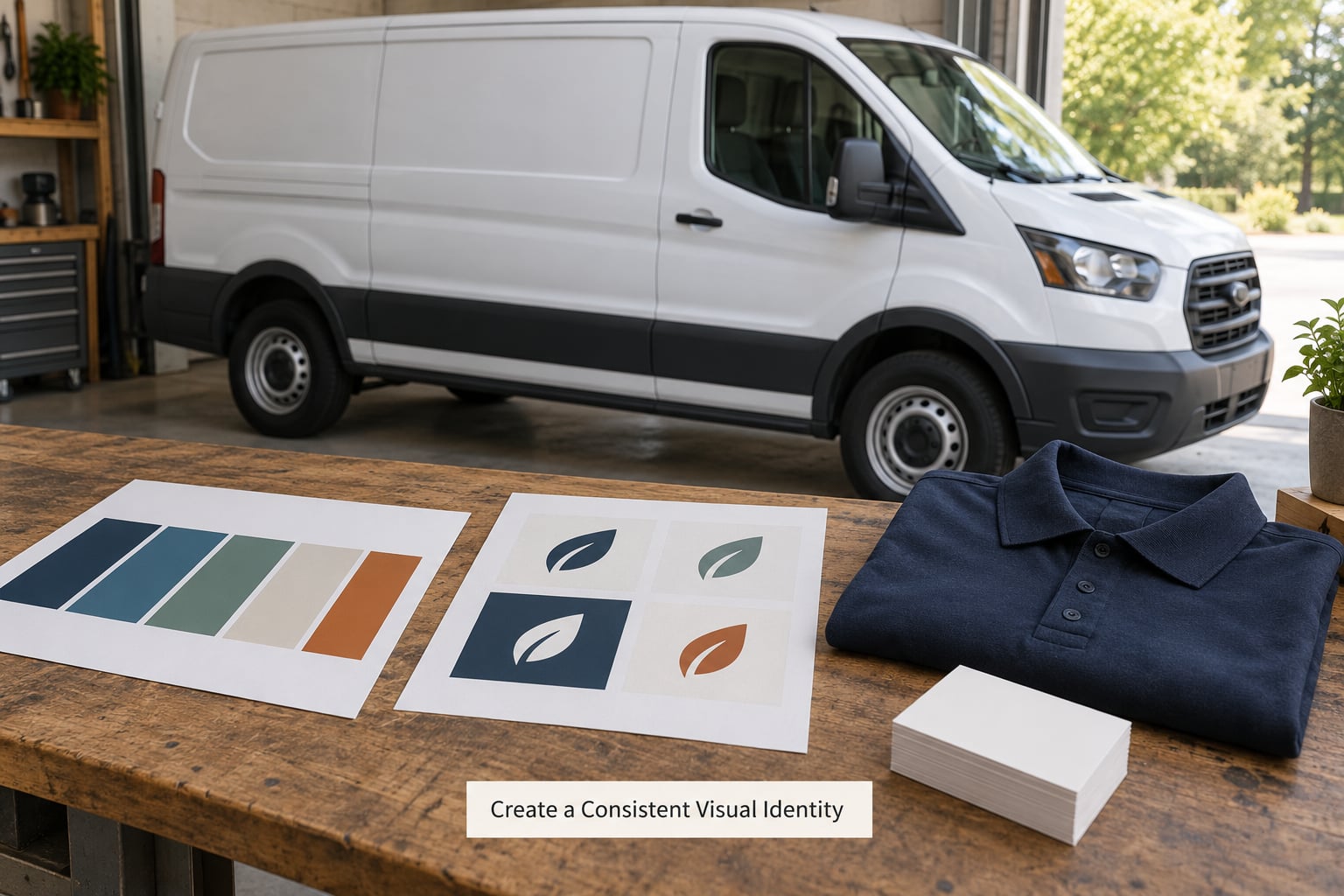
Your visual identity is the set of choices that make you recognizable: logo, color palette, typography, photography style, and voice. For a mobile business it has to survive being shrunk to a shirt chest, printed on a receipt, and read from a moving car.
A few practical rules. Keep the logo readable in one color, because vinyl cutting and embroidery do not care about your gradient. Use one color as the dominant field and one for contrast, not five competing accents. Pick a plain sans-serif for details and let the business name carry the personality. Shoot your job photos in daylight on a clean background so a before-and-after looks like it belongs to the same business.
Write the voice down too — three words, plus one do and one don’t. “Plain, calm, specific” with “never joke about a customer’s stain” is more useful to a technician than a paragraph of adjectives.
4. Design Vehicle Graphics That Communicate Quickly
The vehicle is your storefront, and it has design constraints a shop window does not. It moves, it gets dirty, it sits in sun and rain, and the reader has about three seconds.
Prioritize the information in this order: business name first, then the service in two or three words, then phone number and short URL, then anything optional such as license number or a tagline. Put the name where it is not interrupted by a door seam or a handle, keep the phone number large enough to be read from a driveway rather than a windshield, and place contact details on a panel that stays visible when the tailgate is open.
Test legibility by standing a safe distance away — roughly a car length — and reading it aloud. If you cannot, the type is too small. Pick light lettering on a dark panel or the reverse, and avoid mid-tone colors that vanish in shade or glare.
Full wraps, partial wraps, and cut vinyl decals all work; a partial wrap on the rear panels plus door lettering is usually the better balance of visibility and durability for a service vehicle that washes itself for a living. Compare the material and finish differences before you commit, because the van you buy next may not be the van you have now.
5. Make Every Customer Touchpoint Match
Recognition is built by repetition. The same name, logo, colors, and phone number should appear on the website or booking page, the Google Business Profile, social accounts, email and text replies, quotes, invoices, uniforms, job-site signs, and the follow-up message after the job.
Two touchpoints do most of the work for most operators. The first is the Google Business Profile, because it is where local search sends people and where your reviews live. Use the exact business name from your documents, upload the same logo and the same vehicle photo, and write the description in the words customers actually type.
The second is the uniform. A clean shirt or jacket with a small logo, clean shoes, and a visible work ID does more for customer trust than any ad. Owners posting in small-business forums keep repeating the same point: people decide whether to let a stranger into their driveway partly based on how the person looks when they arrive. A polo with the logo is the cheapest trust device you can buy.
Write a one-page brand guidelines sheet so the look survives after you are too busy to brief a new hire. Include logo files, the two or three colors with their codes, the fonts, a do-and-don’t list, and the voice words.
6. Promote the Brand Locally
Most mobile service businesses grow through local visibility, so the channels are unglamorous and effective.
- Search profiles. Claim and fully complete Google Business Profile, then keep the service area, hours, photos, and categories accurate.
- Local directories. Fill out the free listings that matter for your trade and use identical name, address, and phone details everywhere.
- Referral materials. A card or a magnet with the promise, the phone number, and a QR code to the booking page, handed over at the end of every job.
- Email or text follow-up. One message after the job asking for a review, and one reminder before seasonal work.
- Direct outreach to property managers and local businesses. A short, specific message beats a flyer left in a mailbox.
- Community partnerships. Realtors, landlords, car dealerships, and neighborhood groups are referral sources for mobile services.
- Vehicle visibility. Route planning that keeps you in the neighborhoods you named in step one.
Do not spread a small budget across five platforms. Pick the one place your customers already look and do it well.
7. Measure Requests and Improve the Brand
Branding is judged on booked work, not on likes. Track calls, text inquiries, website visits, quote requests, booked jobs, where those jobs came from, and how many customers come back.
A simple approach is a column in your booking log labeled “how they heard about us” with a short dropdown: search, referral, vehicle, repeat, other. Ask at the door if you are not sure; most people answer.
After a month or two, look at what moved. If calls come from the vehicle but nobody mentions the website, put more effort into the graphics. If quote requests are high and booked jobs are low, the problem is the promise or the pricing on the page, not the logo. If one ZIP code produces most of the revenue, narrow your service area list on your profile and spend your marketing there.
Common Mistakes
These are the branding mistakes that come up most, with the fix for each.
- Choosing a generic logo. A stock badge or a clip-art wrench says nothing and looks borrowed. Fix: use your business name as the primary logo and keep the symbol simple.
- A name that reads as a different kind of business. “Mobile” in a name is often read as phones or as a shop on wheels. Fix: pair the word with the service and check how the name looks written on a van door.
- Listing too many services. A van advertising detailing, plumbing, roofing, and lawn care confuses search engines and customers alike. Fix: lead with the job you want more of and let the others live on the website.
- Unreadable vehicle text. Small type and low-contrast colors disappear at distance and in shade. Fix: cut the detail, enlarge the name and phone number, then read it from a car length away.
- Relying on one social platform. Discoverability on a single app leaves you dependent on an algorithm. Fix: treat social as a support channel and keep your own booking page and profiles complete.
- Changing the look between materials. A different logo on invoices and a different color on the shirt makes you look like three businesses. Fix: one logo file, one palette, one font pairing, used everywhere.
- Not asking for reviews. Owners often build the identity and forget the proof. Fix: ask at the end of every job and make it a one-tap link in your follow-up message.
- Measuring activity instead of revenue. Follower counts and impressions do not pay wages. Fix: track quote requests and booked jobs by source.
Two habits keep all of this alive: re-read your brand guidelines before any new material goes out, and once a year check that your name, logo, and phone number still match across every profile and vehicle.
Frequently Asked Questions
What should a mobile service business put on its vehicle?
Put the business name first in large type, the service in two or three words next, and a phone number plus short URL below that. Keep the name clear of door seams and handles, and place contact details on a panel that stays visible when the tailgate is open. Test it by standing a car length away — if you cannot read it from the driveway, the type is too small.
How do I choose a logo for a mobile service business?
Choose a logo that works in one color, at small size, and on a moving vehicle. Most service businesses do best with the business name as the primary logo and a simple symbol as a supporting mark. Skip thin lines and light gradients, since vinyl cutting and embroidery cannot reproduce them. Ask the designer for a simplified version sized for a shirt chest and a door panel.
How can a mobile service business get more local customers?
Complete your Google Business Profile fully, keep local directory listings identical in name, address, and phone, and ask every customer for a review at the end of the job. Add a referral card or magnet with a QR code to your booking page, and contact property managers and local businesses directly. Route your vehicle through the neighborhoods you chose to serve.
Should every mobile service vehicle have the same branding?
Yes, at minimum the same business name, logo, colors, and phone number on each vehicle, in the same placement. Secondary vehicles can use a lighter treatment such as door lettering and rear panel graphics rather than a full wrap. Keep an extra decal set on hand, since vehicles get damaged, replaced, and sold, and consistency across the fleet is what customers recognize.
How do I know whether my mobile business branding is working?
Track booked jobs by source rather than impressions. Add a simple field to your booking log for how each customer heard about you, and ask at the door when you are unsure. After a month or two, compare calls, quote requests, booked jobs, and repeat work. If quotes are high but bookings are low, fix the promise and pricing before touching the logo.
Start with the step most operators skip: write down who you serve and what makes you different. Everything after that — the name, the logo, the van graphics, the shirt, the profile — gets easier to judge once that sentence exists.